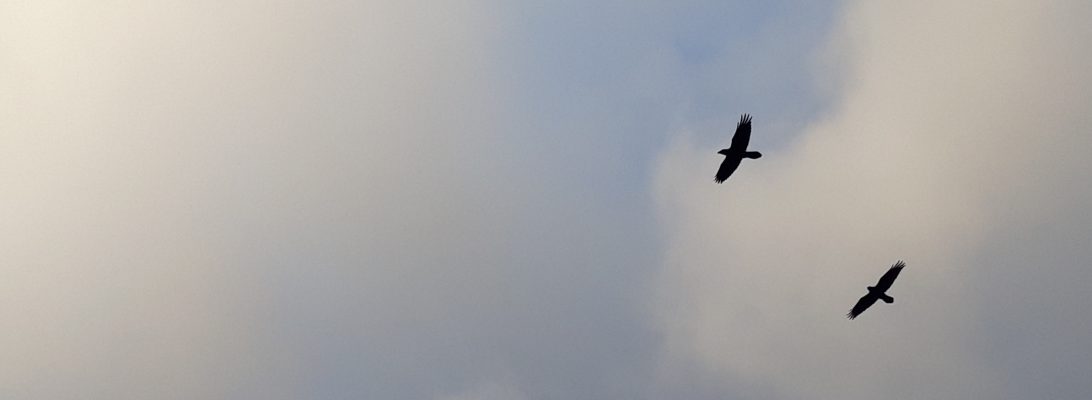
As we drove home from town along the south shore of Loch Eil, my son exclaimed ‘look at the geese mummy!’. It turned out he meant gulls, hundreds of them, all lifting into the air at once. Flying along the surface of the loch below them was what I first took to be a buzzard. Slowly it dawned on me that the gull being chased by this ‘buzzard’ was not a small herring gull, it was a blackback – and a big one at that. As my sense of scale shifted, a turn in the air revealed the pale flash of the giant persecutor’s tail. My buzzard was a sea eagle.
While buzzards have recovered entirely from past human persecution, sea eagles are still relatively rare. However, these huge birds once lived across the whole of the UK.
In The Nature of Summer, Perthshire writer Jim Crumley points out the number of Highland landscape features named after the eagles that once haunted them: ‘Wherever Gaels and eagles have co-existed, there you will find crags, buttresses, rock faces and rock outcrops bearing the same name’. Iolaire: eagle. One of the smaller hills to the west of Glen Nevis, Bidein Bad na h-Iolaire, is one such example. But those eagles came into competition with humans.
A 2012 study for the British Trust for Ornithology indicated that 1500 years ago there were between 800 and 1400 pairs of white-tailed eagles across Britain and Ireland. That number had reduced to an estimated 150 pairs by the beginning of the nineteenth century. Another one hundred years later, in 1916, the last breeding pair were reported on Skye. Two years later they were extinct in the British Isles. Their names on our maps were the only echo of the eagles’ former presence.
A re-introduction scheme began in 1975, orchestrated by NatureScot (previously Scottish Natural Heritage) and the RSPB. As a result of the scheme there are now over 100 breeding pairs in the Highlands, but their fortunes are by no means secured. The previous loss of eagles from this landscape is largely attributed to human activity – and we are still here.
Leaving aside for the moment the more widely publicised disappearance of eagles over sport grouse-shooting moors, eagles pose a potential threat to the human landscape due to their predation of livestock. In an attempt to counter any negative impact of the reintroduction scheme, NatureScot also created a White-tailed Eagle Action Plan. The plan, which is to be reviewed this year, offers support to farmers and crofters as well as trialling prevention measures.
Sheep are bred and cared for by people as a livelihood: a livelihood that puts a roof over our heads, that puts food on the table. By the same token, sheep taken by sea eagles are the birds’ livelihood; they put food in their belly, they provide the energy needed for the bird to live. Both humans and birds live off the landscape, but human and bird are still challenged to find a place for the needs of the other.
We have a 1500-year history of intolerance towards the infringements of the white-tailed eagle into our lives; it seems we are taking small steps towards co-existing again.
Originally published as Wild Words Column, Lochaber Times, Issue 8531, Thursday 1 October 2020
 Kirsteen Bell