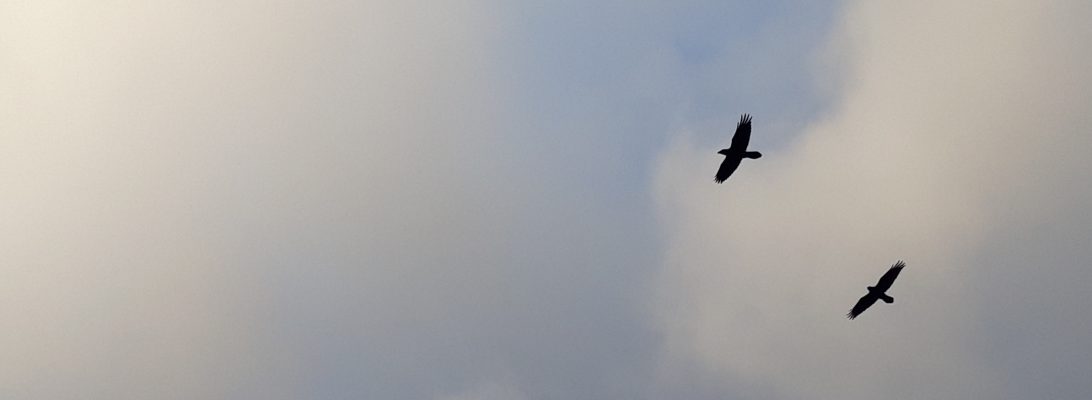
For all that they are bare, the trees still hold some colour at this time of year. The bright green of oak lichen can glow neon, catching and reflecting what little winter light there is. And, where woodland has regenerated naturally, the oaks are surrounded by the deep red-purple of mad-haired birch.
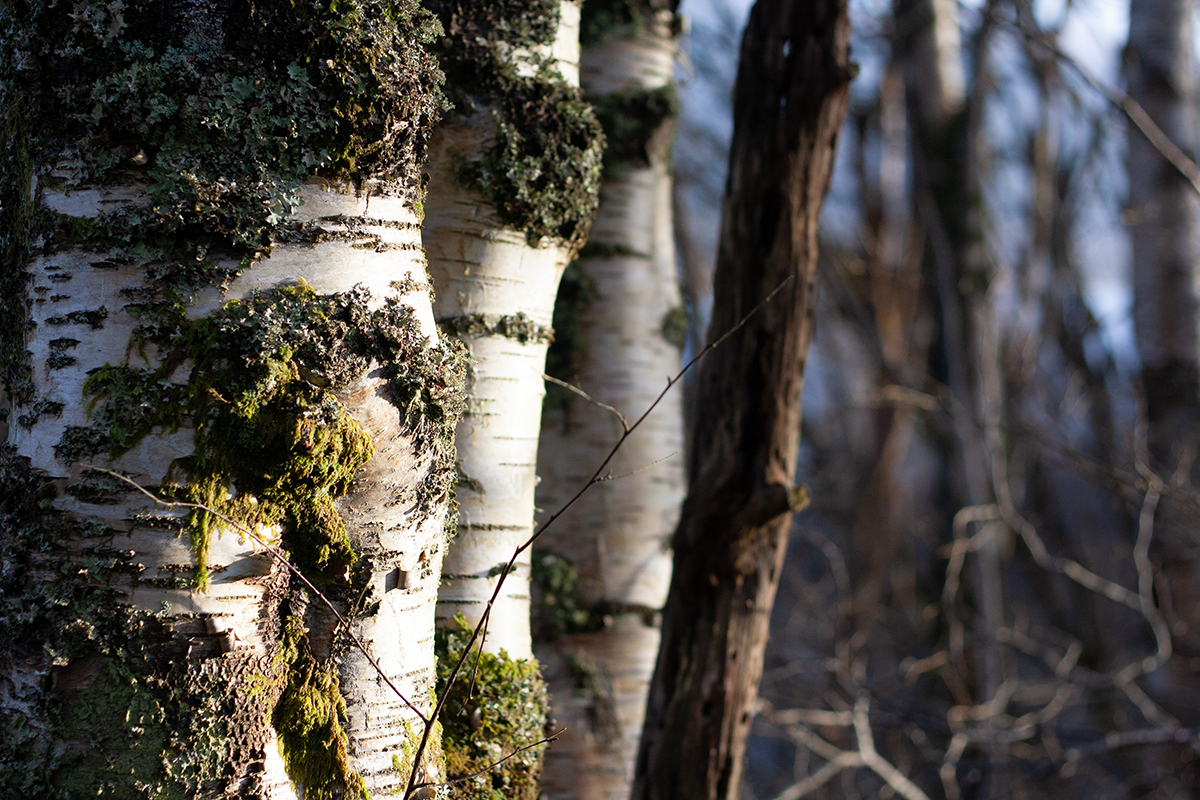
Up close, the hue of the birch’s outermost branches dulls to brown. It is stark against the pale bark, which peels in papery curls around horizontal scores and fissures.
George Monbiot, in the seminal 2013 ‘rewilding’ book, Feral, speculates that those fissures might have evolved because birch trees once shared the landscape with elephants.
Birch grew before the last ice age, and Mr Monbiot thinks it is not unfeasible that elephants roamed amongst them. The dark splits tearing their silvered surface could have been an evolutionary mechanism to prevent browsing elephants from stripping the tree completely. I’m not sure how playful Monbiot intended the theory to be, but, walking with the dog through woodland on the croft, I am delighted at the thought of an elephant grazing the canopy around me. Sounds ridiculous, right?
But it’s an extreme example of shifting baseline syndrome. Every generation has their own perception of what constitutes a healthy ecosystem, based on their lifetimes’ experience. The result is that ecosystems can change drastically over aeons, with humans protecting only their own small idea of a functioning ecosystem and the relationships within it.
Skip a few millennia from the elephants to just 50 years ago, when Catherine MacLennan of Port Appin was writing for The Herb Society of America about the wines she made from the trees around her home. She writes, ‘The time for tapping the Birch trees is when the leaf buds are swollen ready to open, usually early March’.
It seems to have been more common then for crofters to bore a hole in the trunk of a birch, gathering sap Mrs MacLennan describes as ‘clear and sparkling’. Where tapping in Canada became wide-spread and industrialised with maples, in Scotland it is now a cultural curiosity.
That said, my niece began the practice four years ago, after watching a video of a Swedish girl birch-tapping, and discovering that her great-uncle, a crofter, also used to make his own birch wine.
Cards on the table, I don’t think we’ll be getting an elephant on the croft (although wouldn’t it be marvellously bonkers?). But I might have a go at birch tapping. Some relationships with the birch may not have shifted too far into distant memory to be wholly forgotten.
First published in Lochaber Times 20th February 2023
 Kirsteen Bell