Holly harvest

I am advancing through the woods with a pair of sharp kitchen scissors in hand, my heading set by a gleam of green. It’s early, the sun is only just edging around the Ben in the east. Light filters weakly through wet air, softening the edges of birch and oak around me – but not the sharp points of the holly tree I am here to see.

The ground underneath is littered with leaves blown from the oaks further up the bank, mouldering shades of burgundy and brown, and a pair of yellowing ribwort leaves missed by the deer, by the winter, protected maybe by the lower holly branches.

This single holly tree sits brightly by a group of pale birch. It is tall, half my height again, but still a sapling. The crown leaves have not yet forgotten their need to be spiky. Nearby, the trunk of a young rowan has been fractured by the shouldering weight of stags: its broken branches demonstrate how far the holly needs to grow before it is out of the deer’s browsing reach.

Holly is common in the understory of oakwoods, even a tiny one like this. When faced with the emptiness of dark gnarled wood, you can see why its shine and colour are so closely associated with Christmas and yuletide. Evergreen and crimson, it is a burst of brightness as we approach the depths of winter. The smooth verdant surface of the leaves invites touch – were it not for those points that snag and scratch. And fruit that ripens in winter is a gift, though it needs a frost to sweeten the bitter berries for the birds that will eat and disperse its seeds.

It is too young to be prolific in fruit yet, this wee tree that could live for 300 years if left alone. Will these woods even be here then? At first, I spot only one berry, and, having just been reading Robin Wall Kimmerer, I pause before snipping the branch. In Braiding Sweetgrass, she writes about the Honourable Harvest, the agreement between people and land in which you take only what you need: ‘Never take the first. Never take the last. … Leave some for others’.

I take a photo of the one red berry instead. However, the longer I stand there, getting my eye in, waiting for the morning light to curl around the tree’s tips, more red starts to pop out. Eventually I spy a branch with a cluster of three little berries. I step in closer, scissors ready. This scant trio are less than half of what the tree still holds, and they are exactly what I need.

Storming of the woods

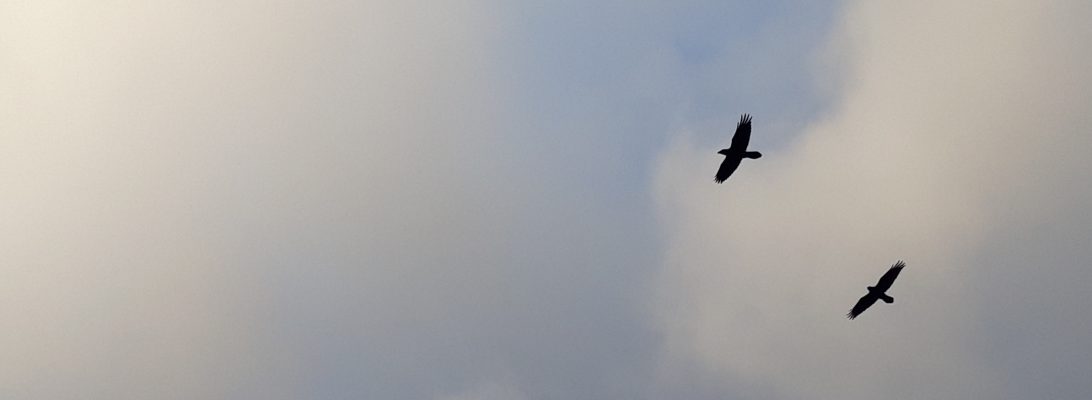
These trees are normally quiet. We might hear the occasional blackbird song, or finches, or the alarm calls of tits and wrens, or the steady voice of ravens from above, the odd carrion crow. But this morning I walk up the hill to a raucous melee. I’m not even close to the woods before I hear a roiling mass of squeaks and curls, chortles and chips, a soundtrack sped up then run backwards and layered over itself again and again. So loud and persistent is the noise that it even swells briefly over the metallic hammering of a rockbreaker from the nearby landfill. If dictionaries had audio descriptions, clustered around the word ‘cacophony’ would be the calls of winter thrushes on the hunt for fruit.

I’ve been away for almost a fortnight and thought I might have missed this storming of the woods. We get only a fraction of the thousands of fieldfare and redwing that migrate to the north of Scotland from their breeding grounds in Scandinavia, eastern Europe, and western Russia. They come every year though, a burst of life when the Highland hills are giving up their green.

When I left for my trip in the last week of October, the rowans were still heavy with berries. Now they are finally bare.

The birds come for our autumn fruit and milder winters. Flocks flutter in like leaves lifted from branches by wind, breezing through this small belt of woodland in a brief, noisy, gathering, before moving on, leaving the rowan exhausted of their fruit. A few dried berries are left dotted on the branches here and there, and a scattering in amongst the leaf litter looks like the debris at the end of a party.

I always thought our visitors were fieldfare, but my newly downloaded Merlin Bird ID app tells me it hears redwings too. I sit by the scope in the garden, waiting for some to stray into the trees by the house so I can watch them more closely. They throng to and fro across the leafless birch, and the oaks still crinkling with brown leaves, searching for any rowan that they might have missed on the last pass. These, I am sure, are fieldfare: grey-blue blurs in the air, their undersides flashing white in the low morning sun. Then I spot two wee ones in the trailing upper branches of a silver birch – they stay long enough for me to train the glass on their perches, and even before I have increased the magnification I can see the rust glow on the side of their breast, the distinct creamy-white line above their eye. Little redwings, in amongst the fieldfare. Birds of a not-quite-the-same-feather flocking together, both drawn to the Highlands’ rowan red bounty.

Invisible cities emerge

Early mornings have been hidden here by Loch Eil in the last few days. Walking out into the garden is to walk into the midst of a cloud. Intangible feather-white air is dense enough to hold within it the loch, the hills, the houses on the north shore. The road is evidenced only by the spectral whoosh of a car engine rolling across the haze. A single gull call pierces through from the water, unseen, below. Around the house, the only shapes that emerge from the mist are the dark bulks of the closest trees. All others are vanished.

These water particles, extracted from the air by overnight cooling of land, shroud the world around us – but in doing so they reveal another world that is veiled from human eyes in the clarity of day.

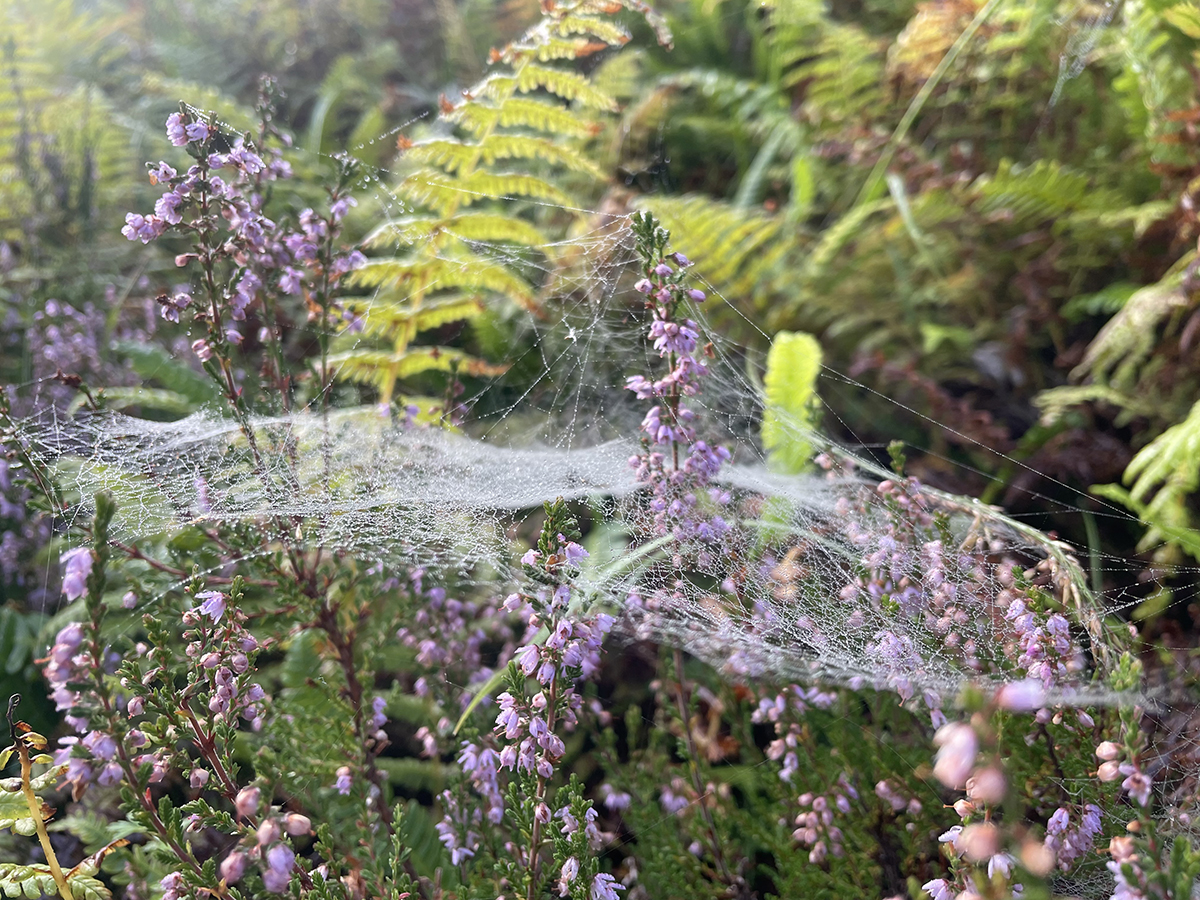
Water droplets cling to silk thread, slung imperceptibly and industriously across the vertical and horizontal and all the angles in between. Spiders’ webs. Everywhere you look. In the rushes and long grass, in the heather and fern, across the kids’ swing-frame, in the wire fence, and in a tall shepherd’s crook of a pale blade of grass, another civilisation is constructed around ours.

I read that there are almost three million spiders for each one human being, globally. Where the impact of almost 8 billion people is starkly evident on the entire surface of this planet, an estimated 21 quadrillion spiders live largely undetected, carrying out their invisible service of capturing and consuming billions of other insects.

For a brief moment, the fog that hides all else gives substance to their insubstantial structures.

Soon though, the sun’s warmth begins to reach through and the mist starts to dissipate, lingering only above the treetops and in the wee corrie tucked into the hill. Bright splashes of rowan red emerge from the trees, and gold-green specklings of birch. The web cities cling on, ghostly, vanishing slowly to the naked eye as the world around them intensifies into blue, green, and the beginnings of bronze.

By mid-day, the sun is high, the cloud now just tendrils that leave the faintest shadow on the hilltops. Wind sweeps in from the west, coming in through our open windows like a cat and knocking over a lamp. Going to right it, I look out again to the web in the heather by the house that I’d photographed that morning.

From a distance it is no longer visible – perhaps gone altogether – but as I peer closer, I see that it is still there, wavering in the wind. Its weaver, a common sheetweb spider, or money spider, clings on underneath. 

First published in Lochaber Times September 2024. Republished here with permission.

Lifting the green veil

Nine of us have gathered in the open grass of the hotel garden; grand white building on one side, leafy woodland on the other, with a sweeping field beyond dissected by a path that leads down to the loch. The sound of traffic going over the Ballachulish bridge is softened by distance, and all is otherwise still. We are staring at our feet.

Crouching down and reaching into the grass, Lucy advises us, “Your lawn will never be the same again.”

Lucy Cooke, also known as The Wild Cooke, runs workshops to share her foraging skills, passing on knowledge that once would have been common but has long been lost to so many. 

We start with white clover, most of us tentatively nosing the round cluster of petals, catching its sweet, honeyed scent, before we watch Lucy confidently pop one in her mouth and follow suit with our own nibbles. My senses (and having a sure teacher) tell me that this is good. My mind must make a conscious effort though to awaken itself to these instincts. Self-heal, daisy, yarrow, ribwort and broadleaf plantain follow: we’re asked if we can detect the mushroom undertones of the plantain, and initially I can’t. It’s on the second pass that my tastebuds detect a faint earthy hint beneath the astringent green. Can green be a flavour? I find myself falling back on it in my notebook, again and again in the absence of other words to describe these new-old flavours.

As we meander slowly, Lucy talks about how the Western diet now includes barely any bitter foods, and how frequent foraging can change and refine our palates. In just a few short hours we’re introduced to a landscape full of texture, the swathe of green around the woodland becomes ling and bell heather, wild raspberries, blaeberries, elder, chanterelles, nettles, and vetch; the salt marsh becomes orache, scurvy grass, sea aster, samphire, sea campion, sea arrow, sorrel, and silverweed. The names alone are poetry. Picked out and placed on our tongues, the woods and shoreline become alive with a possibility we knew must be there but had no knowledge with which to access. This well-known foraging phenomenon, of getting the eye in, of being able to see the edge of things – of noticing – is called lifting the green veil.

Sure enough, in the days that follow, the tangle of random growth in the banks and ditches around my house starts to define. I harvest clover, and now have a jar of dried flowerheads on the shelf beside the Tetley for tea. When I gather salad from the polytunnel I pick both spinach and leaves off the fat hen I was previously weeding out. And on the road by the shore, on verges I’ve walked past time and time again, for the first time I see the pale shine of silverweed where before there was only green.

https://www.thewildcooke.com/

First published in Lochaber Times July 2024. Republished here with permission.

Dream Garden

A friend I’ve never met might be coming to visit next week. It would be her first time visiting our house, and she told me about a dream she’d had, months ago, in which I showed her and her family around my garden. We know each other only through Instagram. In the same way that the images we post on social media don’t always give the full picture, I am worried that the garden she dreamt of was more beautiful than the one I have – that my garden will disappoint.

While I see other gardeners taking part in No-Mow May, letting their lawns bloom wild for spring pollinators, we ended up cutting our grass in anticipation of our son’s birthday party. I have never planted flowers, my excuse being that our regular deer – a group of red stags and a family of roe deer – would eat them. The polytunnel is still bare, only recently vacated by hens whose house went into the tunnel for avian flu lockdown and didn’t come out for a year; instead of the tomatoes, pea shoots, beetroot, courgettes, strawberries, or butternut squash that we’ve grown in previous years, there is only bracken uncurling through otherwise empty soil. It looks like I don’t care.

I keep thinking though of the opening lines of a Karine Polwart song, Take Its Own Time: ‘you ceased to mow the lawn 10 years ago, you just wanted to see how your garden would grow.’ The main sentiment is that the gardener no longer tries to shape their garden, just lets it seed itself and watches to see what will grow. I may not have done much to cultivate beauty or diversity around our house, yet it is there.

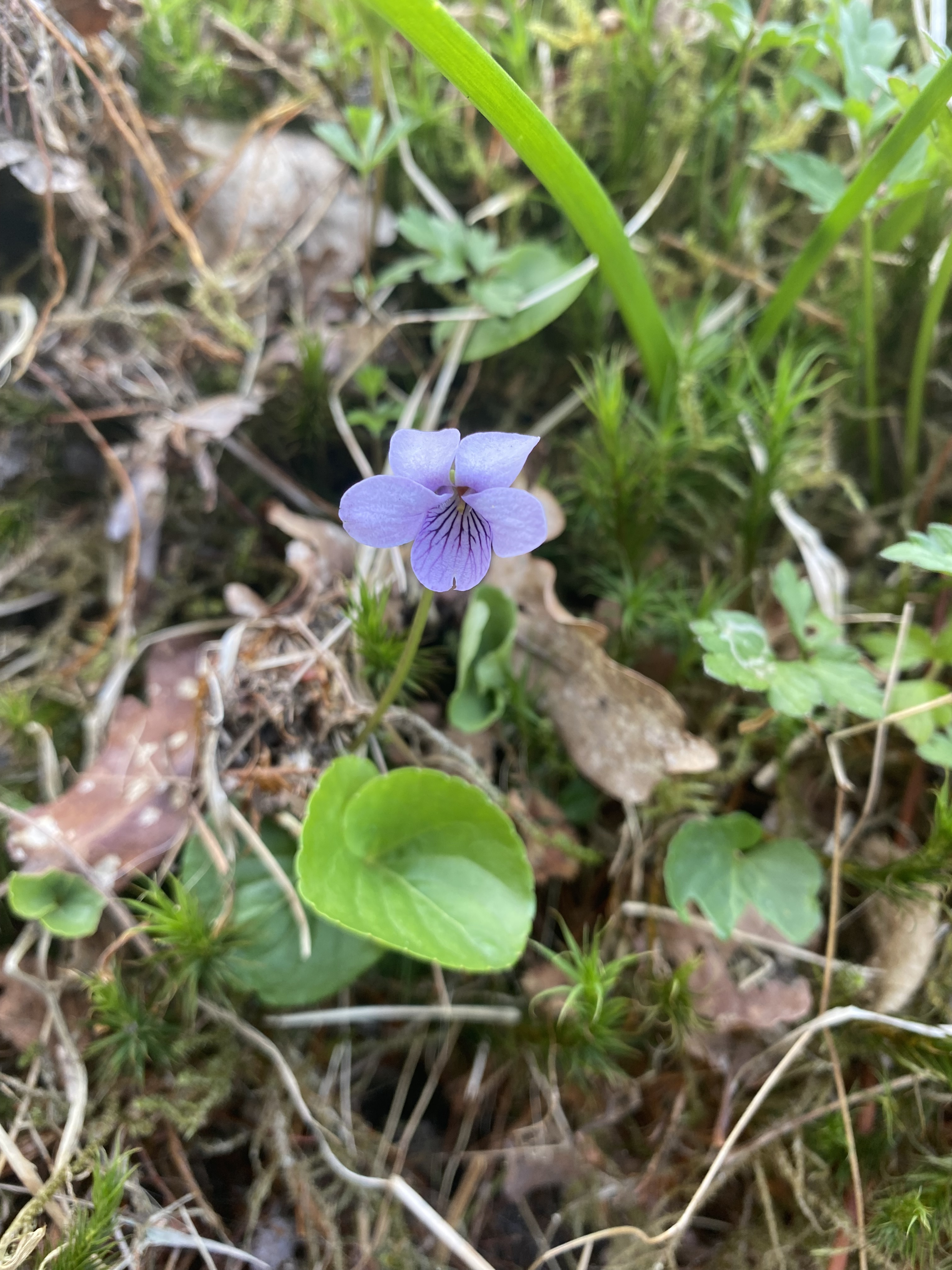
My friend could see the tiny dog violets that have escaped the lawnmower, the daisies growing in rubble that will one day be a patio, and it won’t be long until self-heal flourishes on the earth mounded up by the back drain. Growing through the fence by the empty polytunnel, a crab apple tree holds clusters of gorgeous dusky flowers. I can point to the stone ruins that I soon won’t be able to reach without stepping on bluebells, the place where wild orchids will emerge from the bent grass, or the ditch that will fill with water forget-me-nots. Beyond the side-gate, there are celandines growing in the field, and wood anemones cluster under self-seeded oak and birch. She will have to watch her step where forests of new blaeberry shoots are thriving, and I can pick handfuls of appley wood sorrel for her wee one. Maybe not a garden, but most definitely a dream.

First published in Lochaber Times 10th May 2023

Birch

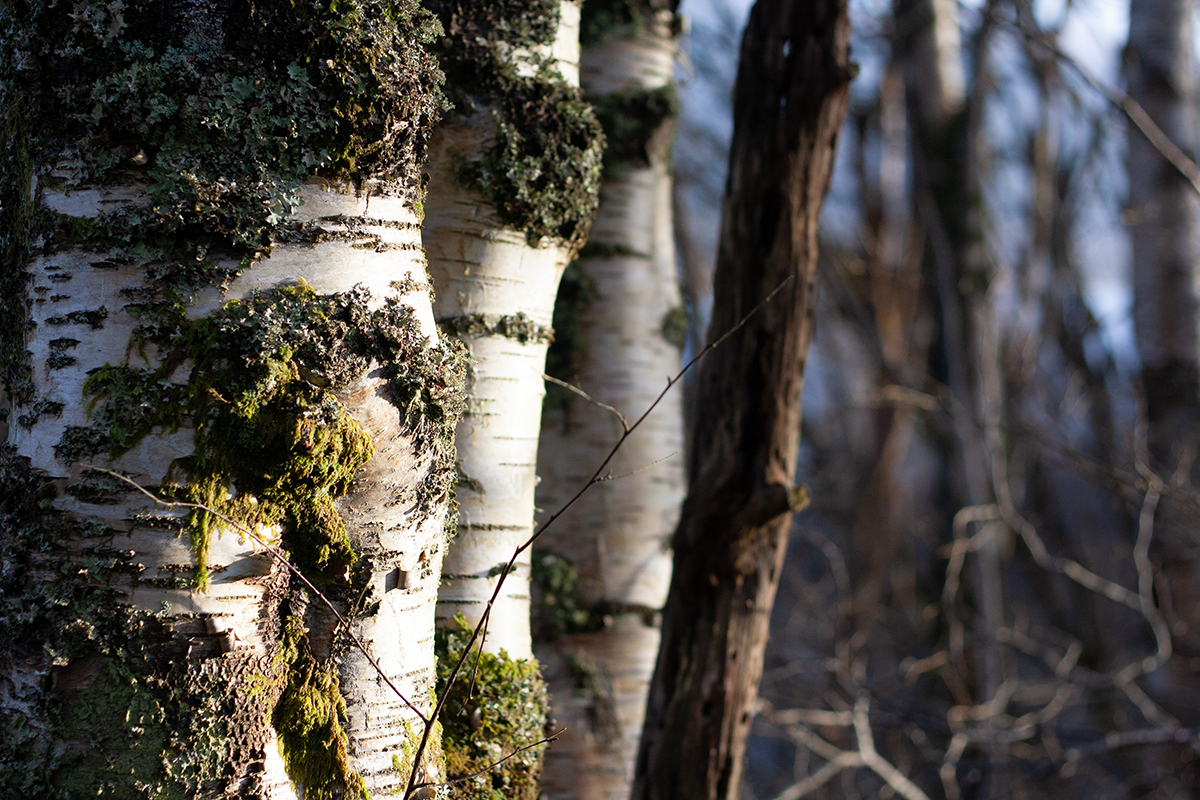
For all that they are bare, the trees still hold some colour at this time of year. The bright green of oak lichen can glow neon, catching and reflecting what little winter light there is. And, where woodland has regenerated naturally, the oaks are surrounded by the deep red-purple of mad-haired birch.

Up close, the hue of the birch’s outermost branches dulls to brown. It is stark against the pale bark, which peels in papery curls around horizontal scores and fissures.

George Monbiot, in the seminal 2013 ‘rewilding’ book, Feral, speculates that those fissures might have evolved because birch trees once shared the landscape with elephants.

Birch grew before the last ice age, and Mr Monbiot thinks it is not unfeasible that elephants roamed amongst them. The dark splits tearing their silvered surface could have been an evolutionary mechanism to prevent browsing elephants from stripping the tree completely. I’m not sure how playful Monbiot intended the theory to be, but, walking with the dog through woodland on the croft, I am delighted at the thought of an elephant grazing the canopy around me. Sounds ridiculous, right?

But it’s an extreme example of shifting baseline syndrome. Every generation has their own perception of what constitutes a healthy ecosystem, based on their lifetimes’ experience. The result is that ecosystems can change drastically over aeons, with humans protecting only their own small idea of a functioning ecosystem and the relationships within it.

Skip a few millennia from the elephants to just 50 years ago, when Catherine MacLennan of Port Appin was writing for The Herb Society of America about the wines she made from the trees around her home. She writes, ‘The time for tapping the Birch trees is when the leaf buds are swollen ready to open, usually early March’.

It seems to have been more common then for crofters to bore a hole in the trunk of a birch, gathering sap Mrs MacLennan describes as ‘clear and sparkling’. Where tapping in Canada became wide-spread and industrialised with maples, in Scotland it is now a cultural curiosity.

That said, my niece began the practice four years ago, after watching a video of a Swedish girl birch-tapping, and discovering that her great-uncle, a crofter, also used to make his own birch wine.

Cards on the table, I don’t think we’ll be getting an elephant on the croft (although wouldn’t it be marvellously bonkers?). But I might have a go at birch tapping. Some relationships with the birch may not have shifted too far into distant memory to be wholly forgotten.

First published in Lochaber Times 20th February 2023

Magpie

On an average day, the most common bird I see here is the raven. They circle the skies with the gulls and I have counted scores of them winging across the loch at dusk to roost. But in Ayrshire and Glasgow, where I grew up, it was their pied cousins, the magpie, that most often caught my attention.

With their white breast and wing stripe, and velvety black head, back, and tail that shine iridescent blues and greens in the light, the magpie is instantly recognisable. Their long straight tail points neatly behind them whether in flight, or bobbing along the ground.

Back in Ayrshire for two weeks this summer, I resumed nodding ‘hello maggie’ at any single magpies hopping along the edge of the motorway. The greeting comes from the rhyme ‘One for Sorrow’. I guess the superstition is that you stave off sorrow by acknowledging the bird – you would imagine they’d need all the help they could get in that proximity to thousands of speeding cars – but I think the sorrow is the lonely magpie’s, so by saying hello you are extending your friendship.

Watching a pair dig about in a hanging basket in my friend’s garden, it occurred to me I now miss my wee daredevil pals.

For, though magpies are prevalent across the UK and Ireland, they are absent from the Highlands. Something about our mountainous region puts them off – maybe the lack of motorways? In truth, lack of habitat connectivity is a possible influence on magpie distribution. These scavengers thrive in proximity to urban populations, where they have greater opportunities to access food. We are the magpie’s friend in more than superstition.

High sandstone walls surround my friend’s garden, which is one of a row of gardens near the edge of a town. Large sycamore trees hang over each wall. All the time I was there I could hear magpies laughing from deep within the leaves.

To me, their chittering call sounds like mirth. However, according to one etymology website, the birds used to be known only as ‘pies’, and the ‘mag’ was a 16th century addition referring to the ‘idle chatter’ of women. I bristled at the implication – and yet I sat alone in my friend’s garden, as I was house-sitting for her while she was on holiday elsewhere. I had to admit that if she had been there, our cackles would most likely have joined the magpie’s.

One for sorrow, two for joy,

Three for a girl, four for a boy,

Five for silver, six for gold,

Seven for a secret never to be told,

Eight for a wish, nine for a kiss,

Ten for a bird you must not miss.

First published in Lochaber Times 26th July 2022

Bluebell Seeds

Near our house is a birch woodland. From late May until June its green understory has been flush with the purple-blue hues of bluebells. Now though, the flowers are setting their seeds, retracting into little round cases full of next year’s growth.

In her poem Reliquary, Kathleen Jamie suggests that the casting of those seedpods is an act of hope:

The land we inhabit opens to reveal

the stain of ancient settlements,

plague pits where we’d lay

our fibre-optic cables

but witness these brittle August

bluebells casting seed,

like tiny hearts in caskets

tossed onto a battle ground.

I can’t decide if the battle ground in the poem is between humans and bluebells, or between humans and humans in our ever-changing and ongoing use of land. Maybe it’s both. Either way, every year the bluebells return here and, as the petals wane, Jamie’s words bob up out of my memory again. I think about balance.

In Braiding Sweetgrass, biologist Robin Wall Kimmerer writes about a study of Native American practices of harvesting sweetgrass. It showed that some species benefit from a symbiotic human/land relationship. The original research asked if it was better to harvest by pulling the plants up root and all, or to cut the plant, leaving the roots intact. The scientists left a separate area untouched by human hand, simply as a control to gauge the test sites against.

But it was that control plot that suffered. Unharvested dead vegetation quelled fresh growth. The areas in which harvesting techniques were tested all had a flourishing grass population. Technique aside, the key was to take no more than 50%. 

While the sweetgrass study focused on the success of an individual species – not on general land use – I recognise a little of the approach in the way we work with the croft.

The bluebells blossom in the dappled sunlight and shade of the trees. Birch were the pioneer species in ground that was left to seed itself. Occasionally, deer or sheep would pass by, the animals’ hooves digging divots into the earth. A biologist friend tells me that those hoofprints created little safe pockets for birch seeds to land and flourish.

You can see this happening again elsewhere on the croft. One tiny field had pigs in it two years ago, its dark soil churned up by their hungry snouts. And you cannot walk in it now without stepping on a miniature forest. Hundreds of ankle-height birch that – if left to grow – could create more woodland, thus more opportunity for bluebells to thrive. As it is, another pair of kune kune pigs will be in the enclosure soon. These grazing pigs relish the tree shoots growing amongst the summer grass.

The birchwood and bluebells by the house, though, remain untouched. Woodland here, pasture there: give and take, fifty/fifty. It’s working for us.

First published in Lochaber Times 20th June 2022

Deer Bums

My kids asked the other day, “why do deer have white bums?”. I had a vague idea it was related to warning, or escaping from danger. I told them deer raise their tail when alarmed, letting the rest of the herd know that there is something to worry about – I did make a mental note to check my facts later.

The red deer seem close and fearless now. Not in the bold and belligerent manner they have during rutting season – more like they see us, but don’t care. Two in the field by the house nudge their way across the boggy ground towards better grazing: a stag with short black antler furred with regrowth, and a golden-backed hind. When I walk closer, they only lift their heads, briefly returning my look, and return to browsing.

However, they view our jumpy 4-month-old collie differently. The same pair were cruising slowly into the woodland near the top of the hill as I walked up behind them with the dog. When we reached the outer birch trees, the deer had moved out of sight. But the puppy stopped stock-still, nose pointed towards the space where they had been. Just as I asked her what else she saw (in the way we do with puppies and babies, not really expecting an answer), she yapped loudly, sending me out of my skin.

At the dog’s bark, the two deer appeared from behind a clump of hazel – except it wasn’t two at all. Their light rumps were revealed as they turned away from us, picking up speed as their heavy brown bodies bobbed lightly over the fence, then two more, then more again began to flow up the hill; a paper chain of pale hearts, disappearing into the trees.

In the Forward to Understanding Animal Behaviour (Whittles Publishing, 2019), Rory Putman says that he is writing for amateur naturalists like myself. Following the recommendation of a friend, I turned to the book to ask if Putman could shed any light on my very loose conclusions about the deer behaviour. Sure enough, he observes that many social mammals have developed calls or actions ‘which ‘warn’ other members of the group or feeding assemblage of potential danger and allow them to take some evasive action’. He talks about roe deer fluffing up ‘the hair of their white rump patch into an extremely obvious ‘powder-puff if they scent or see a predator’ then running off. Or the African springbok, ‘who flare their magnificent white rump patch and make a series of high leaps into the air, ‘pronking’ ostentatiously as they run.’

The roundish white rear-ends of red deer appear a little like easily tracked target; it seems contradictory that they evolved in defence. Putman suggests it is altruistic, one for the good of the herd: ‘…behaviour which advertises the presence of the predator to other must act, quite by reverse, to draw attention to yourself, while allowing others to escape.’

Standing at the bottom of the hill, I caught only glimpses of those pale rumps before they vanished completely. To the following herd, they may have been as bright as airport landing lights – this way to safety.

First published in Lochaber Times 27th May 2022