Cormorants

Standing at the head of Loch Eil on a still day, clouds can fill your vision. The path between water and sky is clear, separated only by the distant slopes of Aonoch Mòr and Ben Nevis in the east. In Mary Mackellar’s poem about this loch (posted to Facebook recently by the Lochaber Local History Society), she describes the mountains as ‘stretching in all their grandeur/ far down in its blue deep’.

What you will also find, far down in the loch’s blue deep, is cormorants.

There isn’t a day goes by that you don’t see them. In the water, their dark bodies sit just below the surface. Their long, thin necks and hooked bills rotate like periscopes. Diving to hunt fish, they might resurface 20 or 30 metres away.

Cormorant’s feathers are not waterproof, which reduces buoyancy and means they can dive to depths of around 10 metres. So they perch on mussel floats and rocks to dry their wings in the spring sunshine. This is when they are at their most recognisable; their dark wings spread angelically wide, facing the wind.

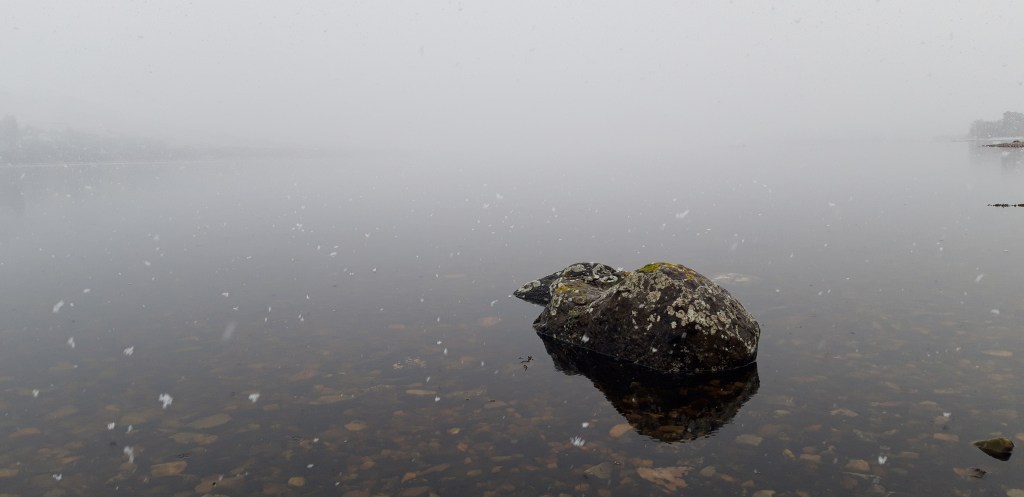
There is a large stone in the water near the head of the loch, known as Mackintosh’s Rock. The name may be because of a 16th-century battle held between Clan Mackintosh and Clan Cameron, at which the Mackintosh chief was killed. Another, equally morbid story I’ve been told, places the origin of the name around the Jacobites. Either way, these days it is used by the birds.

Always proud of the water regardless of the tide height, the rock is a standing post for gulls, oystercatchers, herons, and of course, the cormorants.

Normally I only glimpse them from the car as I pass. But recently I stopped, perching myself on a stone at the shore. Black from a distance, on closer inspection cormorants have an oily, iridescent sheen. They are also bigger than I imagined, almost a metre tall.

One stretches its neck forward, its body elongating horizontally. I’ve not watched them like this before, so I wonder what it is doing – just as it projects a long stream out onto the rock. Oh. I remember now my father-in-law struggled to keep them off his boat: when it was out on its mooring they liked to roost on the mast, which led to an unpleasant clean-up job for him.

As I try to edge closer to this pair, they decide they have had enough of me. They launch themselves in a low glide down across the still water, their wings slapping against the surface, feet trailing a line of white foam like the vapour trails of aeroplanes in the clouds above.

First published in Lochaber Times, March 25, 2021
Ravens – Heralds of Life

Tuesday 2 February was Imbolc, or St. Brigid’s Day, or Candlemas. Underneath all these names, halfway between the winter solstice and the spring equinox, is the slow return of life.

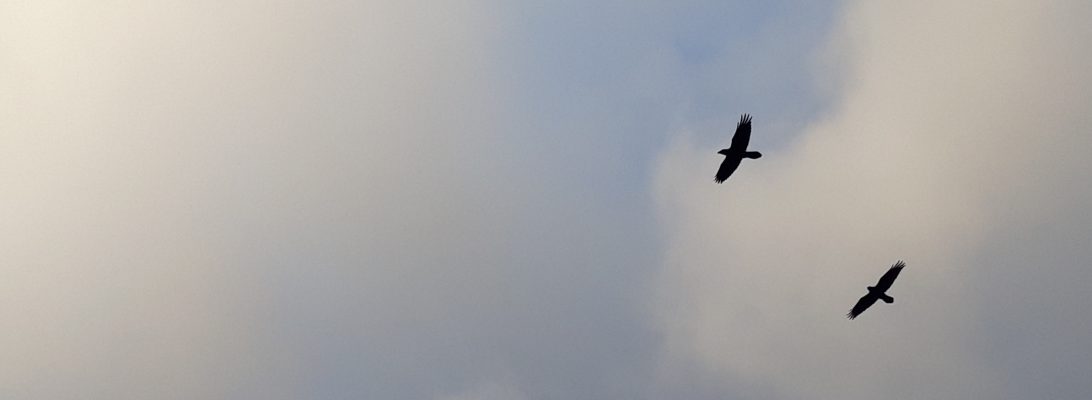
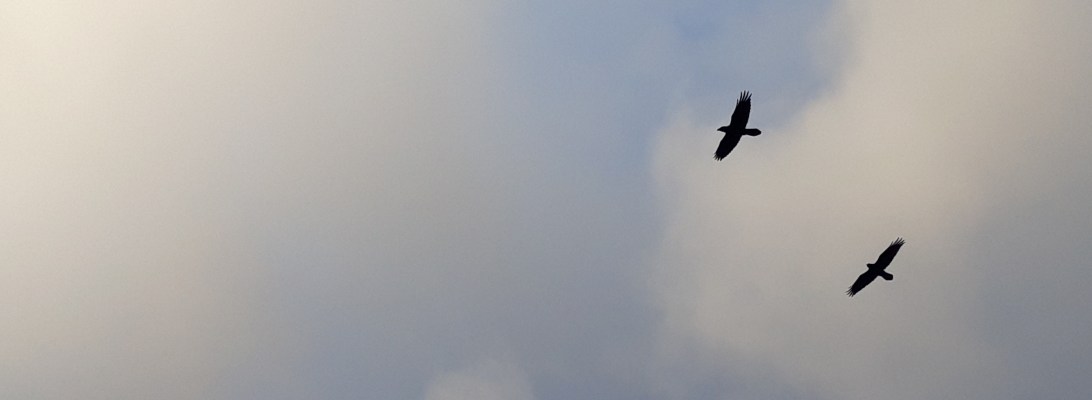
The skies are edging towards lightening earlier and darkening later. Between times they are scored through with the flight of ravens, buoyant on the frigid north wind. Pairs lift and curl in their nuptial flight, the males mirroring the birling females. If they get the steps to the dance right, they have a chance of becoming a mate; the successful twosomes will have eggs in the coming weeks.

Everything below them though is still biding its time; the ground is frozen hard. There is no give at all in earth that normally slides beneath my boots.

I am itching to create new beds this year: pumpkin, kale, and turnip are all neatly laid out in an excel spreadsheet on my computer, hundreds of miniscule seeds wrapped in brown paper in their drawer. Waiting in the darkness for the ground to be released.

I did notice the first garlic shoot the other day, a few millimetres of green spearing the frosted crust of soil below the pallets that lie across the tops of the beds. At first the barrier of wood was there to stop the hens digging up the seedbulbs, and now it stops the sheep from eating those fresh, bold shoots.

Some of the sheep are rotund, expectant with lambs. It is difficult for them to fill their bellies though. They nibble anything and everything they can find, and it still isn’t much. They are not our sheep – there is no cattlegrid now to stop them wandering off their own grazings ground, and they make a mess around our unfenced house – but I don’t chase them at this time of year. I realise in retrospect that by chasing them last year I have done them a favour: I have protected some grass for them to eat now. Elsewhere the moss and lichen growing up the sides of the oak trees have been cleared as far as each sheep’s desperate neck can reach. They even bite the softer rushes down.

That said, these sheep will probably be fine. In Highland Folkways, historian Isabel F Grant records that the hardiness of blackface and cheviot was one reason they prospered in this landscape. They can survive a winter on the hill. Introduced in the eighteenth century, they replaced the more delicate breed – now lost – that Highlanders had kept mainly for milk, before the Clearances changed the habits of lifetimes. Habit is why these sheep are here now. It draws them back to the ground on which they were born to have their own lambs.

We sit on a cusp, midway between the darkest night of winter and the first day of spring, Underneath the frost and snow, the swelling of life is almost imperceptible. But it is there, heralded by the ravens.

First published in Lochaber Times, February 11, 2021

Walking on Water

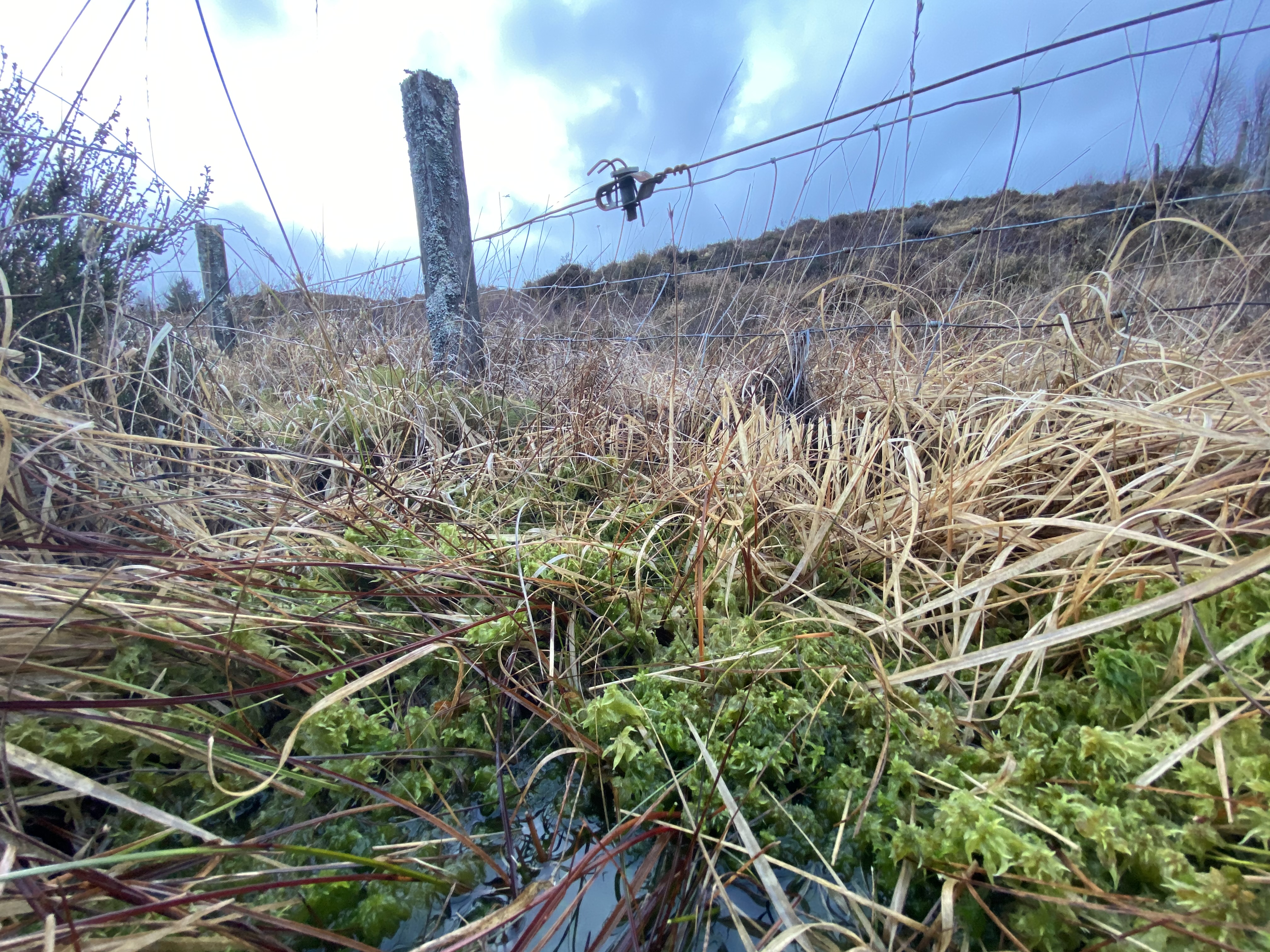
The spell of those few sparkling days of frost has broken. The snow comes and goes, and, on the whole, we have been returned to our rather more wet reality. I am not walking on the hill behind the house, I am wading. The uneven surface of desiccated heather and sedge is saturated and overflowing. This is a landscape built on water – built on moss. 

Mosses depend entirely on moisture to exist. Without it they will not photosynthesise, will not grow green. Their colour is a welcome relief now, in what is otherwise a sea of brown. 

I need a stick to walk up here if I don’t want to end up floundering to and fro in that sea, flapping like a fish out of water. If I forget though, I can always attempt to follow the fence, lurching between each post. I will be thwarted though where a few metres of fence have sunk into the ground, surrounded by pillows of sphagnum moss. 

Standing on the slope above this wee bit of fence, even on a dry day, you can hear trickling all around you. A heel dug into the vegetation reveals a Lilliputian river winding down between the heather stalks. Further exploration reveals countless more, an inconceivable number of flows teeming across this landscape, towards the bowl in which the old fence sits. I have got it the wrong way round: the fence didn’t sink – the ground rose up to meet it. All of this water, all of that rotting sphagnum pooling within it, slowly reforming the surface of the land. 

Only the top bright colour of the sphagnum moss, its capitulum, breathes light. The cells on the leaves underneath are mostly dead, but it is those empty cells that hold the water. They draw it up towards the green that still forms a path through sunlight. And, as the top grows, the old moss underneath is further steeped in the gathered rainfall. Empty space and water become the solid peaty ground that we can walk upon. 

Every year the rain continues to fall from the sky, saturating even the highest ground so that it rarely dries out completely. Every year the sphagnum continues to reach up, out of the old wet growth. Over time that growth becomes compressed, creating and perpetuating the acidic and anaerobic environment through which everything up here roots, forming peat. 

I am surrounded by land that would swallow me if I could stand here long enough. Peat gathers the surface into itself, growing at a rate of around 1mm a year. I am 5 foot 6 inches tall in my bare feet. I would need to stand here for 1,707 years to wholly become a part of this landscape. Add another 50 years for the thick soles of my wellies. I guess I’ll just have to be content with walking on water.

First published in Lochaber Times January 28, 2021

Storing light

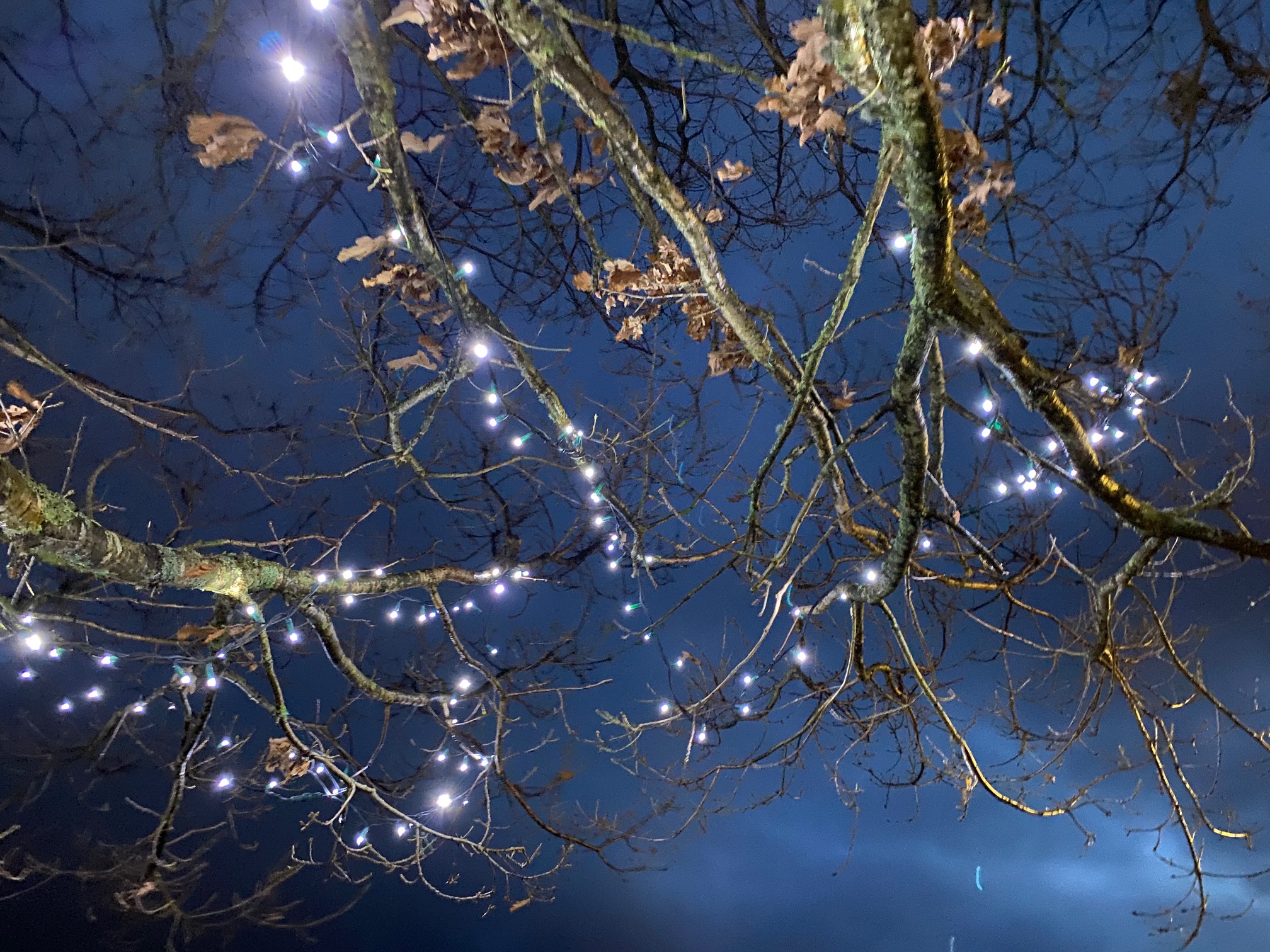
It would be easy to miss the winter solstice, living as we do in a world of artificial light. Walking at night across the field by our house, the eye is drawn away from the black hill, towards the warmth of home. Light spills out of our north-facing windows, falling onto the oak tree like snow. I can go inside, close the curtains, and pay no heed to the rising and setting of the sun.  

On the 21st of December, the northern half of planet Earth was on a tilt away from our central star. While the Southern hemisphere was enjoying its longest day, we were as far from the sun as we would get in the course of the year, pointing out into cold space. But how we must twinkle in that darkness.  

When I was wee, we would look out for the Christmas trees as they popped up one by one, fairy lights brightening the otherwise dark houses. My children now do the same. We live in a world where it is easy to harness the energy previously captured from the sun. Whether that energy comes from solar panels, or by burning oil, coal, or wood, or even from wind power, all depend on the sun at some point in their existence – and so do we.  And so we take that stored sunlight and release it back into our lives.

There was a time when our dependence on the sun shaped the course of our days more directly than it does now. Our genetic ancestors may once have cooried in for the long haul like hedgehogs or bears. Analysis of early human bones, found fossilised in a cave in Northern Spain, has suggested that our hominin predecessors may have hibernated through the darkest seasons. However, the study goes on to say that the damage and disease evident in the bones indicates that, if we did hibernate, it was poorly tolerated. We would tolerate it even less well now without the coping mechanisms we have drawn from brighter days.  

Humans have a long history of gathering light around us when we are furthest from it. The Gaelic words for winter solstice are grian-stad a’ gheamhraidh – literally sun-stop winter. We mark this moment in both words and actions. The traditions surrounding the festivities have changed over the years, depending on human culture: from Maes Howe, the Neolithic chamber in Orkney, built to let a brief burst of sunlight into the tomb on the solstice, to the lighting of candles in houses on Oidhche Choinnle, through to the Christian absorption of Celtic solstice ceremonies, and the arrival of Christmas.  

I love the fairy lights that come with Christmas. I would have them up all year if I could get away with it – but it is only really at this time of year that they come into their own. On the longest night of the year, we light up our world. 

Originally published by Lochaber Times Issue No 8545 Thursday 7 January

Addendum: This was written at the end of 2020. It is now the end of the first month in a new year. My fairy lights are still up, brightening my days.

Autumn colours

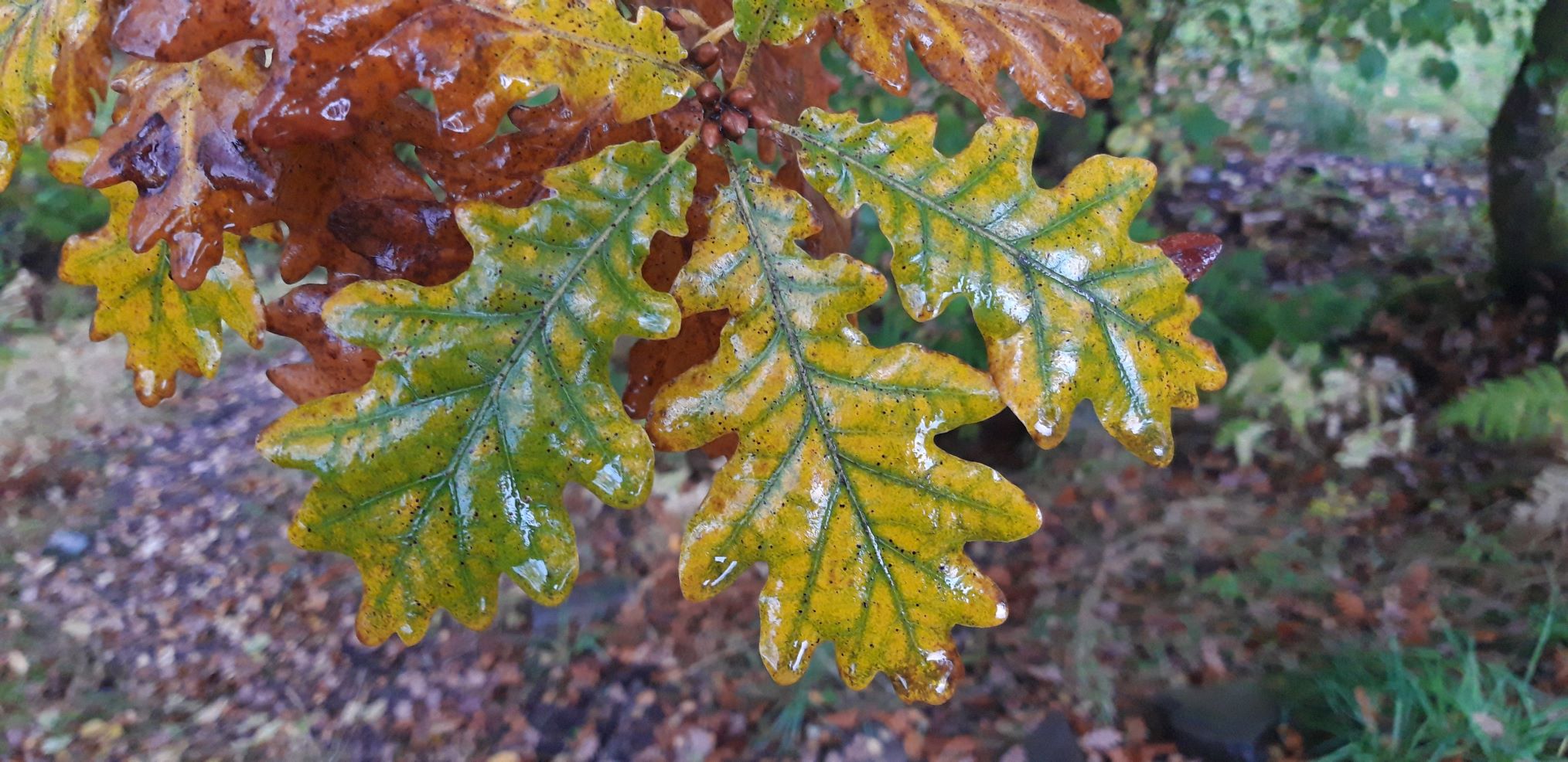
Yellow and bronze oak leaves, still with green chlorophyll in their midribs and veins.

The green hills are singeing into copper and bronze. All around us trees are drifting too into the autumn spectrum. From the yellow birch to the still green oak, with rowan, alder and hazel at varying stages between, the trees and bracken are calling back their chlorophyll.

Chlorophyll is the green pigment that allows the tree to absorb light needed for photosynthesis.  It is green to the human eye because the tree absorbs red and blue light but reflects the green.  Autumn leaves may be a sign of decay, of the trees shedding what is no longer needed, but it is when the trees are at their most energetic that we see most of their waste – green is the colour of light that the tree throws back.

Each tree reaches a point though where they have stored enough sugar under their bark and in their roots, where they cannot store any more.  Or, if they haven’t reached that point, they are forced anyway to withdraw their liquids deep within to protect themselves from the threat of coming frosts.  Unless you are a pine tree of course, then you effectively have anti-freeze in your needles and a thick layer of wax that allows you to keep your greenery all year round.  Deciduous trees however begin to prepare for their winter rest. Their chlorophyl is broken down; the carotene and anthocyanin pigments that remain in the leaves now have their chance to shine.  The sycamores near us are the first to leaf in the spring, and so seem to be of the first to turn; their five-pointed leaves appear like golden stars in a deep green sky. 

The Woodland Trust suggest that the depth of the yellows, oranges, and reds we see each year depends on weather conditions. Cold and dry weather that stays above freezing affects the pigment, giving the leaves a redder hue, as does longer spells of Autumn sunshine.  There is another theory that the vibrancy of the leaves shouts a warning.  The brighter the colour the stronger the tree – the stronger the caution to insects.  These tiny creatures may find a sheltered home for the colder months, but when spring comes this glowing tree will be capable of defence, so they’d better find another, paler, weaker, home.

Warning issued, energy reserves pulled back into the trunk and roots, the tree will seal off its branches. Leaves will be released and fall to the ground under their own weight or in the first wind.   From hereon in the wind will whistle through bare wood; without their leafy sail to catch the air the trees will be safer from storm damage, the colours of spring stored safe within. 

First published in the Lochaber Times, Issue 8536, Thursday 5 November 2020.

Sea Eagle

As we drove home from town along the south shore of Loch Eil, my son exclaimed ‘look at the geese mummy!’.  It turned out he meant gulls, hundreds of them, all lifting into the air at once.  Flying along the surface of the loch below them was what I first took to be a buzzard.  Slowly it dawned on me that the gull being chased by this ‘buzzard’ was not a small herring gull, it was a blackback – and a big one at that.  As my sense of scale shifted, a turn in the air revealed the pale flash of the giant persecutor’s tail.  My buzzard was a sea eagle. 

While buzzards have recovered entirely from past human persecution, sea eagles are still relatively rare. However, these huge birds once lived across the whole of the UK. 

In The Nature of Summer, Perthshire writer Jim Crumley points out the number of Highland landscape features named after the eagles that once haunted them: ‘Wherever Gaels and eagles have co-existed, there you will find crags, buttresses, rock faces and rock outcrops bearing the same name’.  Iolaire: eagle.  One of the smaller hills to the west of Glen Nevis, Bidein Bad na h-Iolaire, is one such example.  But those eagles came into competition with humans. 

A 2012 study for the British Trust for Ornithology indicated that 1500 years ago there were between 800 and 1400 pairs of white-tailed eagles across Britain and Ireland.  That number had reduced to an estimated 150 pairs by the beginning of the nineteenth century.  Another one hundred years later, in 1916, the last breeding pair were reported on Skye.  Two years later they were extinct in the British Isles.  Their names on our maps were the only echo of the eagles’ former presence. 

A re-introduction scheme began in 1975, orchestrated by NatureScot (previously Scottish Natural Heritage) and the RSPB.  As a result of the scheme there are now over 100 breeding pairs in the Highlands, but their fortunes are by no means secured.  The previous loss of eagles from this landscape is largely attributed to human activity – and we are still here. 

Leaving aside for the moment the more widely publicised disappearance of eagles over sport grouse-shooting moors, eagles pose a potential threat to the human landscape due to their predation of livestock.  In an attempt to counter any negative impact of the reintroduction scheme, NatureScot also created a White-tailed Eagle Action Plan.  The plan, which is to be reviewed this year, offers support to farmers and crofters as well as trialling prevention measures. 

Sheep are bred and cared for by people as a livelihood: a livelihood that puts a roof over our heads, that puts food on the table.  By the same token, sheep taken by sea eagles are the birds’ livelihood; they put food in their belly, they provide the energy needed for the bird to live.  Both humans and birds live off the landscape, but human and bird are still challenged to find a place for the needs of the other. 

We have a 1500-year history of intolerance towards the infringements of the white-tailed eagle into our lives; it seems we are taking small steps towards co-existing again.

Originally published as Wild Words Column, Lochaber Times, Issue 8531, Thursday 1 October 2020

Otter and stone

Not an otter

In a monotone world, snow disappearing into still water, there appears a tight swell of movement, full of languid force. Indistinct dark splashes are more often than not a far-off cormorant diving repeatedly for food, but, as the streak loops and circles, my confidence grows that maybe this time it is an otter.  

The hills on the other side of the loch fade as the drift of falling snow deepens. Perspective drifts with it, small or far away becoming blurred so that the twisting shape could be two otters – until it lifts its head and upper body out of the water in a periscope motion, returning a sense of scale. Eventually it submerges fully and I walk in the direction given by its wake, my boots scraping too noisily on stonechips, stilling steps and body in a pantomime freeze each time the otter emerges closer to the shore.

I make it onto the strip of tide-swept grass, free of snow and soft enough to quieten my feet. The grass leads towards an outcrop of basalt which tumbles into a handful of boulders, dark and proud of the pale loch. I am a cold statue as the otter swims towards them, silhouetted oh-so briefly on the surface, before vanishing into the rocks.

Two, three, slow steps. Two, three, more. Every cell alert and leaning towards the creature I imagine to be on the other side of the stone. Another two steps. Poised in expectant motion. Then

Low rumble of a male voice. I hesitate briefly, then step up onto the rock. Through the curtain of snow and branches I can just see two hooded bodies standing at the bank of the wee bay beyond. As I teeter with decision a car alarm goes off – not mine, must be theirs. I give the otter up for lost and turn back, crunching heavily along the shore back to my own car.

I am always on at my children to share nicely, to think of others, to be kind. It is not until I am driving away that it occurs to me that I could have continued to walk towards the people by the loch, whoever they were. Our pincer approach combined with the car alarm may have sent the otter melting away into the water, but what would we have gained – or given – by talking to each other about it?

My experience of nature as it relates to writing is, on the whole, a solitary affair: the ‘lone enraptured male’ so prevalent in nature writing setting a tone for much that followed. While new voices and narratives have emerged in recent years, the form is still predominantly of a single author relaying their own experiences, observations, or understanding of the living world. Some write from the clear self of first-person, others in the quietly human third, while Kathleen Jamie’s use of second-person in Surfacing goes someway to counter this solitude, her ‘you’ reaching out to bring the reader along with her and opening her words outwards. However, no matter the twists and turns of technique, the process of writing tends towards the innate perspective of the author. Or, so I thought.

Then there was Foundle, created by Tanya Shadrick, Jo Sweeting and Louisa Thomsen Brits. I had watched a little of the project’s development via Instagram, slight glimpses into the experience of the growing friendship of three women and its creative flow, in which ‘chance, skill, and intent triangulate to form art’. The emotive strength of their three-fold depiction lies in the balance and attention that each gives to the other and their work: ‘A triangle of women, the strongest shape, the weight of our attention evenly spread. Touching, listening, conjuring collective purpose.’ The idea of new bonds and collaboration was beautiful to see, and to me seemed so very brave. If I imagined myself taking part in such an endeavour, I became petrified, a stony fear creeping out from my centre until my limbs were stilled.

It was that same stone that turned me away from the couple on the shore. It is likely that they saw the otter too, rumbled their car to a stop and crept slowly towards the lochside, cameras poised, hoping to capture the moment, to make it theirs. I had wanted that moment too, senses alive to light and movement in the hope of etching its lines onto my memories, to be reformed in words at some unknown later date. I had not wanted to share.

But, there is something else here now. A testing of the stone. The possibility of a new way of carving words. I am no longer wondering about the missed opportunity of seeing the otter up close; instead, I wonder at the missed opportunity to become ‘we’.

With thanks to Tanya Shadrick, Jo Sweeting and Louisa Thomsen Brits: https://www.littletoller.co.uk/the-clearing/foundle-by-tanya-shadrick-jo-sweeting-and-louisa-thomsen-brits/

Bracken

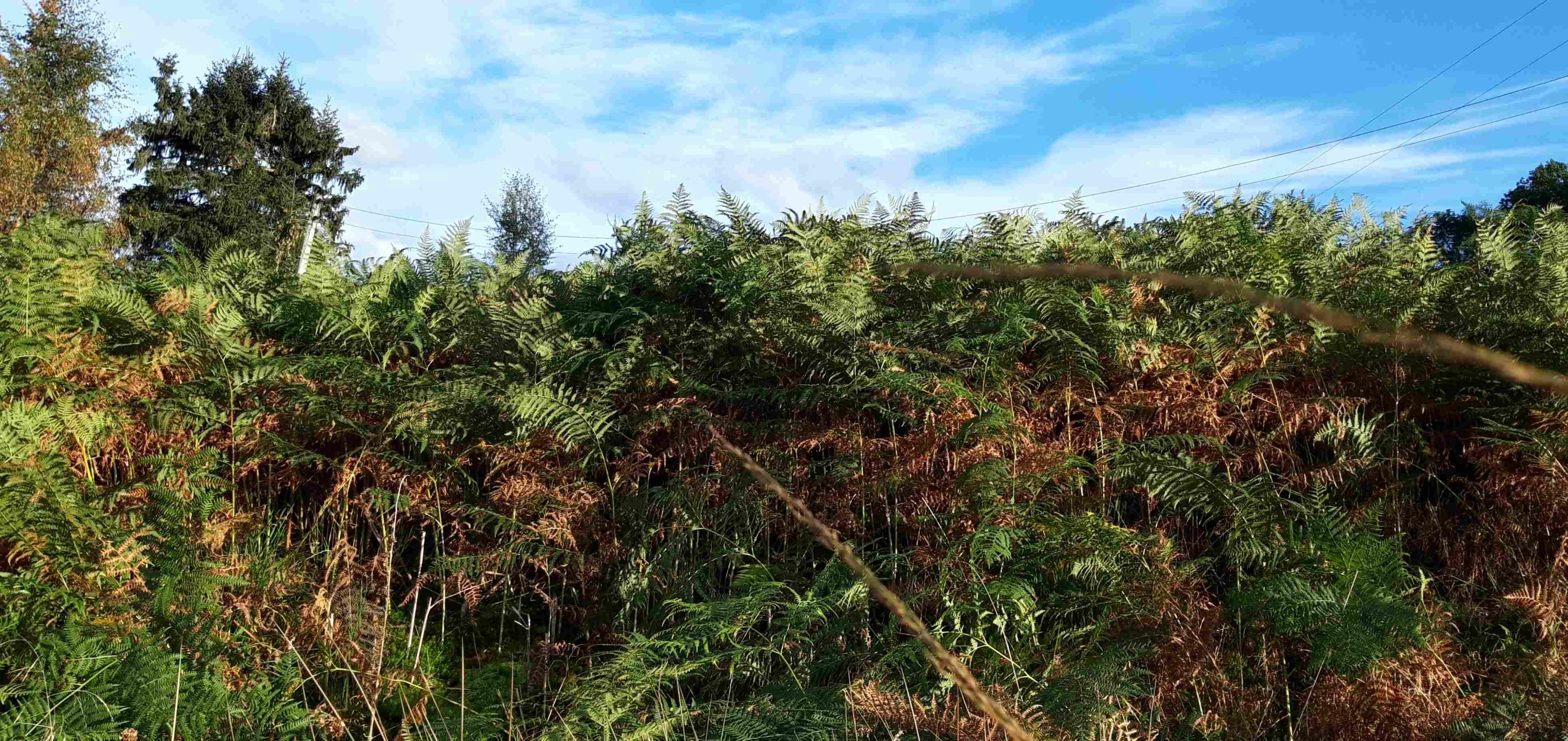
The bracken is dying. The green hills are slowly singeing; yellow, copper, and bronze blending with some still-verdant patches, smirred into an impressionist’s pallet in Loch Linnhe below. A puffer disrupts the vision as it steams down the water, purple-black smoke streaming behind it, a novelty from a fading generation.

Though once used for bedding or mulch, bracken fern is now mainly viewed as invasive, reducing both biodiversity and the grazing territory available to farmers and crofters. To be rid of bracken you must repeatedly knock it back, two, three times in a season. Then you must repeat the process the following year. Year, upon year, upon year. If you do not, if you give the new growth an inch of space and time, it will take it and grow.

Bracken is old and bracken is persistent. Fossil records date it to at least 55 million years ago. It can quickly regenerate from the smallest of roots, rhizomes waiting patiently underground for new shoots to be allowed to unfurl, fiddleheads rising again to play with the wind, to reach above our heads so that in spring the hills ripple with soft green waves.

I cross a stile by the Polldudh track in Glen Nevis, following a path of mud-sunk footprints and flattened grass. Underneath a tall rowan, red berries still clinging to its branches, there is a hint of a gap in the bracken. Someone has already stamped through here – stalks lie snapped at right angles close to the ground. Beyond these, the greener stems slope away from me, their lush heads pulled down by the weakening below, their lower fronds now brown, cracked curls trailing the late September sunshine to its faint ends.

I put my hand out to one withered stalk, running my fingers along its dried pinnae; I thought they would crumble, disintegrate into my palm, but they are surprisingly strong. One curls around my thumb and holds tight as I pull, like a baby’s reflex, tiny fingers gripping mine.

Sound

Standing at the top of the croft and looking down the slope I can hear Lawrie calling to one of our sons. The sun shines hard and white at my back, a welcome change from the dreich grey days of winter. Even at this distance, glimpsed as he is through the birch trees, I can see his face screwed up as he looks for the boy. He is the size of a lego man from where I stand up the hill, yet when I call “Is he there?” with no great force in my voice I hear him answer “Aye”, as if I had been standing just a few metres away.

I am up the hill with a black bin bag and thick gloves, collecting rubbish dropped by the ravens. He is by the house putting up a fence to stop the sheep from destroying the garden. Neither of these activities particularly smack of crofting conventions, but as we call to each other across the ground I am struck that when this croft was created human voices would have carried across the earth, through the air, just the same. I am standing in the winter remains of long grass that in years gone by would likely have had livestock on it, so our voices would have been joined by the animals’ sonorous lowing. As it is, the bass notes now come from the rumble of forestry and landfill lorries on the single-track road by the shore below.

Earlier in the day I had been at the same task in the trees at the back of the croft next door and my phone had started ringing in my back pocket. It had been Lawrie checking that our 5 year old son, who had wandered off in my direction, had indeed found me. If he’d called with his voice alone then I doubt I would have heard him, so what would he have done before we had mobile phones? Downed tools and come to check himself I suppose, or at least come within hearing-shot. As I go further up the croft with my bag now, heading towards an oak beneath which is a midden of pecked-clean mammal bones and plastic food containers, I can still hear the reassuring sounds of the boys shouting at their game. I can hear the metallic thud of the fence-post driver as Lawrie hammers the posts into the ground. Two ravens fly in a straight line above my head; I’m alerted to them only by the soft whupping of their wings in the air. “Aye, it’s your mess I’m cleaning up”, I call up to them. Whether they hear me or not, there is no acknowledgement and they are soon gone.


Some of these short pieces are written as a result of the optional prompt for the monthly meetings of the Lochaber Writers Group.  The prompt for April was ‘Sound’.