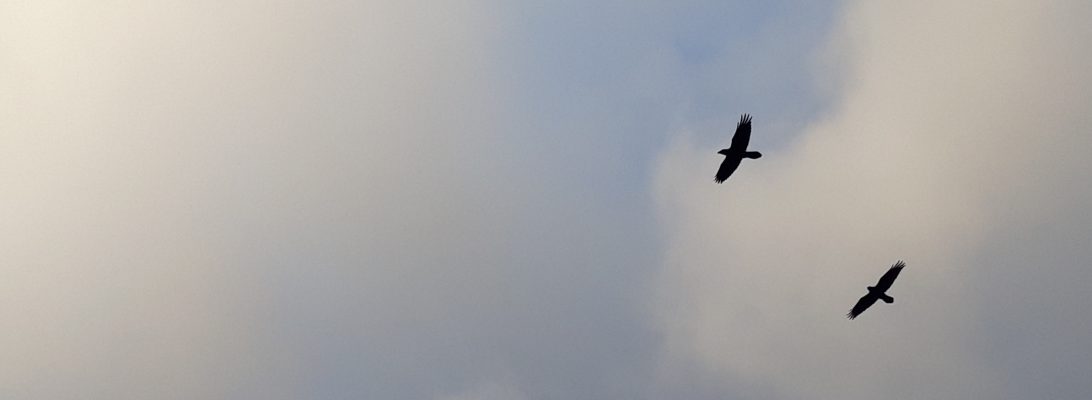
Standing at the head of Loch Eil on a still day, clouds can fill your vision. The path between water and sky is clear, separated only by the distant slopes of Aonoch Mòr and Ben Nevis in the east. In Mary Mackellar’s poem about this loch (posted to Facebook recently by the Lochaber Local History Society), she describes the mountains as ‘stretching in all their grandeur/ far down in its blue deep’.
What you will also find, far down in the loch’s blue deep, is cormorants.
There isn’t a day goes by that you don’t see them. In the water, their dark bodies sit just below the surface. Their long, thin necks and hooked bills rotate like periscopes. Diving to hunt fish, they might resurface 20 or 30 metres away.
Cormorant’s feathers are not waterproof, which reduces buoyancy and means they can dive to depths of around 10 metres. So they perch on mussel floats and rocks to dry their wings in the spring sunshine. This is when they are at their most recognisable; their dark wings spread angelically wide, facing the wind.
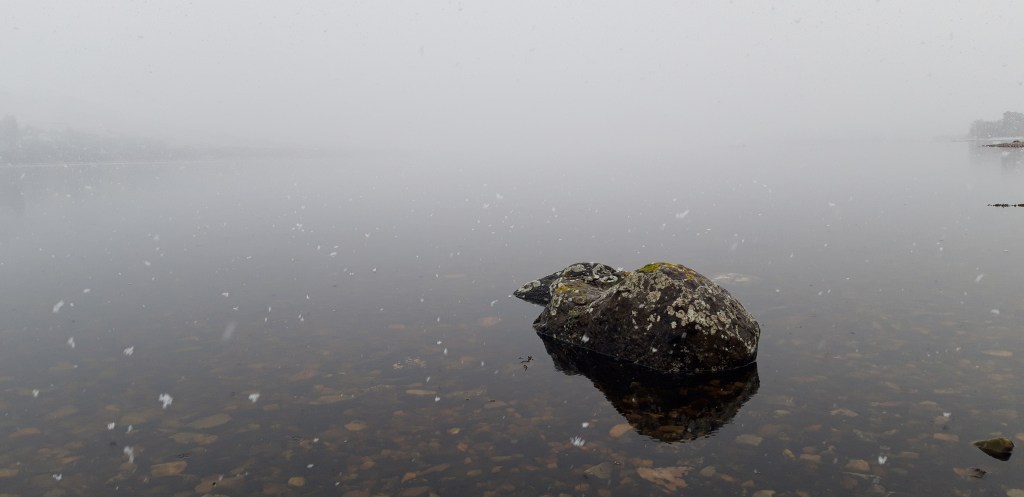
There is a large stone in the water near the head of the loch, known as Mackintosh’s Rock. The name may be because of a 16th-century battle held between Clan Mackintosh and Clan Cameron, at which the Mackintosh chief was killed. Another, equally morbid story I’ve been told, places the origin of the name around the Jacobites. Either way, these days it is used by the birds.
Always proud of the water regardless of the tide height, the rock is a standing post for gulls, oystercatchers, herons, and of course, the cormorants.
Normally I only glimpse them from the car as I pass. But recently I stopped, perching myself on a stone at the shore. Black from a distance, on closer inspection cormorants have an oily, iridescent sheen. They are also bigger than I imagined, almost a metre tall.
One stretches its neck forward, its body elongating horizontally. I’ve not watched them like this before, so I wonder what it is doing – just as it projects a long stream out onto the rock. Oh. I remember now my father-in-law struggled to keep them off his boat: when it was out on its mooring they liked to roost on the mast, which led to an unpleasant clean-up job for him.
As I try to edge closer to this pair, they decide they have had enough of me. They launch themselves in a low glide down across the still water, their wings slapping against the surface, feet trailing a line of white foam like the vapour trails of aeroplanes in the clouds above.

First published in Lochaber Times, March 25, 2021



 Kirsteen Bell