Holly harvest

I am advancing through the woods with a pair of sharp kitchen scissors in hand, my heading set by a gleam of green. It’s early, the sun is only just edging around the Ben in the east. Light filters weakly through wet air, softening the edges of birch and oak around me – but not the sharp points of the holly tree I am here to see.

The ground underneath is littered with leaves blown from the oaks further up the bank, mouldering shades of burgundy and brown, and a pair of yellowing ribwort leaves missed by the deer, by the winter, protected maybe by the lower holly branches.

This single holly tree sits brightly by a group of pale birch. It is tall, half my height again, but still a sapling. The crown leaves have not yet forgotten their need to be spiky. Nearby, the trunk of a young rowan has been fractured by the shouldering weight of stags: its broken branches demonstrate how far the holly needs to grow before it is out of the deer’s browsing reach.

Holly is common in the understory of oakwoods, even a tiny one like this. When faced with the emptiness of dark gnarled wood, you can see why its shine and colour are so closely associated with Christmas and yuletide. Evergreen and crimson, it is a burst of brightness as we approach the depths of winter. The smooth verdant surface of the leaves invites touch – were it not for those points that snag and scratch. And fruit that ripens in winter is a gift, though it needs a frost to sweeten the bitter berries for the birds that will eat and disperse its seeds.

It is too young to be prolific in fruit yet, this wee tree that could live for 300 years if left alone. Will these woods even be here then? At first, I spot only one berry, and, having just been reading Robin Wall Kimmerer, I pause before snipping the branch. In Braiding Sweetgrass, she writes about the Honourable Harvest, the agreement between people and land in which you take only what you need: ‘Never take the first. Never take the last. … Leave some for others’.

I take a photo of the one red berry instead. However, the longer I stand there, getting my eye in, waiting for the morning light to curl around the tree’s tips, more red starts to pop out. Eventually I spy a branch with a cluster of three little berries. I step in closer, scissors ready. This scant trio are less than half of what the tree still holds, and they are exactly what I need.

Storming of the woods

These trees are normally quiet. We might hear the occasional blackbird song, or finches, or the alarm calls of tits and wrens, or the steady voice of ravens from above, the odd carrion crow. But this morning I walk up the hill to a raucous melee. I’m not even close to the woods before I hear a roiling mass of squeaks and curls, chortles and chips, a soundtrack sped up then run backwards and layered over itself again and again. So loud and persistent is the noise that it even swells briefly over the metallic hammering of a rockbreaker from the nearby landfill. If dictionaries had audio descriptions, clustered around the word ‘cacophony’ would be the calls of winter thrushes on the hunt for fruit.

I’ve been away for almost a fortnight and thought I might have missed this storming of the woods. We get only a fraction of the thousands of fieldfare and redwing that migrate to the north of Scotland from their breeding grounds in Scandinavia, eastern Europe, and western Russia. They come every year though, a burst of life when the Highland hills are giving up their green.

When I left for my trip in the last week of October, the rowans were still heavy with berries. Now they are finally bare.

The birds come for our autumn fruit and milder winters. Flocks flutter in like leaves lifted from branches by wind, breezing through this small belt of woodland in a brief, noisy, gathering, before moving on, leaving the rowan exhausted of their fruit. A few dried berries are left dotted on the branches here and there, and a scattering in amongst the leaf litter looks like the debris at the end of a party.

I always thought our visitors were fieldfare, but my newly downloaded Merlin Bird ID app tells me it hears redwings too. I sit by the scope in the garden, waiting for some to stray into the trees by the house so I can watch them more closely. They throng to and fro across the leafless birch, and the oaks still crinkling with brown leaves, searching for any rowan that they might have missed on the last pass. These, I am sure, are fieldfare: grey-blue blurs in the air, their undersides flashing white in the low morning sun. Then I spot two wee ones in the trailing upper branches of a silver birch – they stay long enough for me to train the glass on their perches, and even before I have increased the magnification I can see the rust glow on the side of their breast, the distinct creamy-white line above their eye. Little redwings, in amongst the fieldfare. Birds of a not-quite-the-same-feather flocking together, both drawn to the Highlands’ rowan red bounty.

Storing light

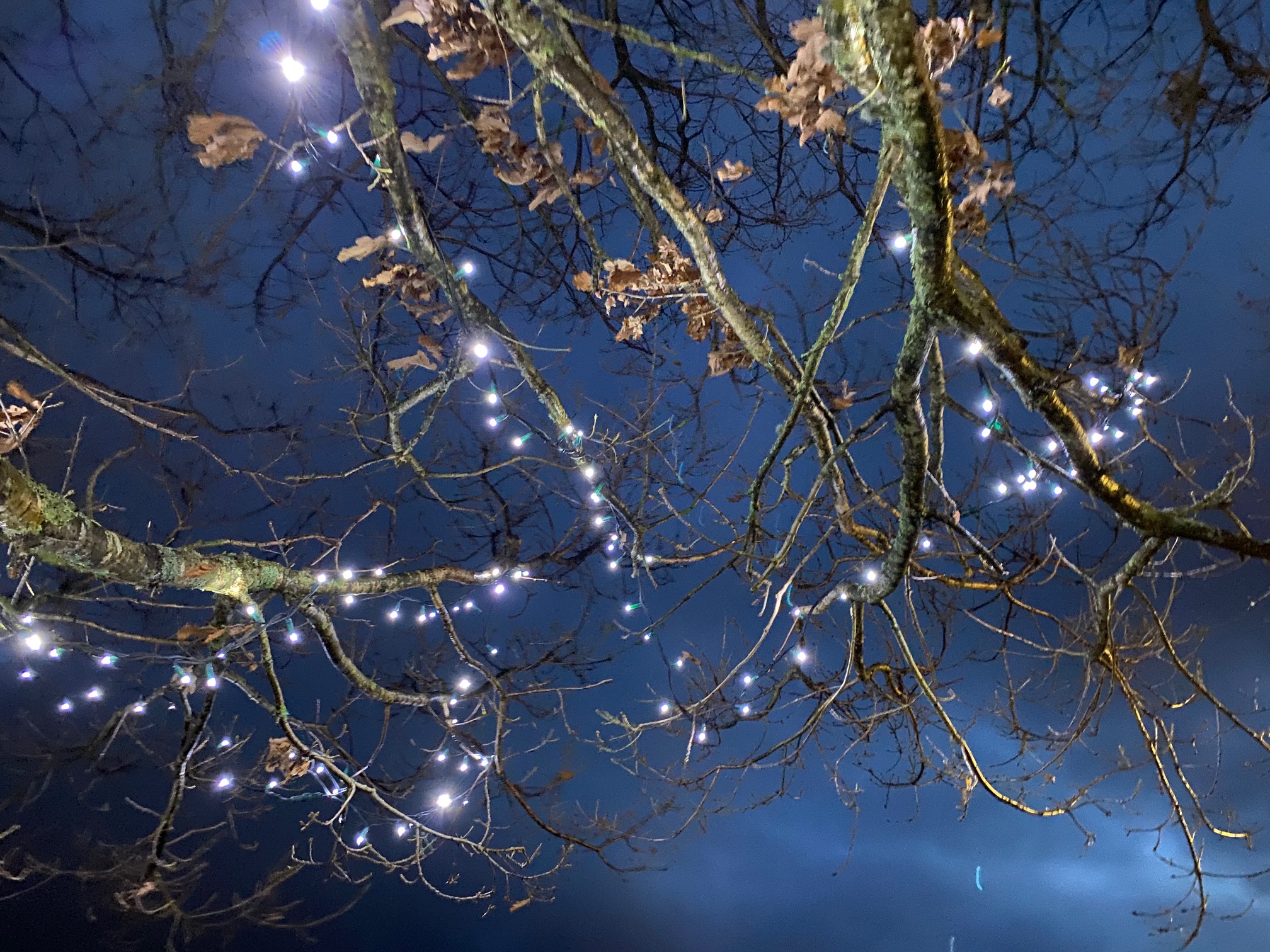
It would be easy to miss the winter solstice, living as we do in a world of artificial light. Walking at night across the field by our house, the eye is drawn away from the black hill, towards the warmth of home. Light spills out of our north-facing windows, falling onto the oak tree like snow. I can go inside, close the curtains, and pay no heed to the rising and setting of the sun.  

On the 21st of December, the northern half of planet Earth was on a tilt away from our central star. While the Southern hemisphere was enjoying its longest day, we were as far from the sun as we would get in the course of the year, pointing out into cold space. But how we must twinkle in that darkness.  

When I was wee, we would look out for the Christmas trees as they popped up one by one, fairy lights brightening the otherwise dark houses. My children now do the same. We live in a world where it is easy to harness the energy previously captured from the sun. Whether that energy comes from solar panels, or by burning oil, coal, or wood, or even from wind power, all depend on the sun at some point in their existence – and so do we.  And so we take that stored sunlight and release it back into our lives.

There was a time when our dependence on the sun shaped the course of our days more directly than it does now. Our genetic ancestors may once have cooried in for the long haul like hedgehogs or bears. Analysis of early human bones, found fossilised in a cave in Northern Spain, has suggested that our hominin predecessors may have hibernated through the darkest seasons. However, the study goes on to say that the damage and disease evident in the bones indicates that, if we did hibernate, it was poorly tolerated. We would tolerate it even less well now without the coping mechanisms we have drawn from brighter days.  

Humans have a long history of gathering light around us when we are furthest from it. The Gaelic words for winter solstice are grian-stad a’ gheamhraidh – literally sun-stop winter. We mark this moment in both words and actions. The traditions surrounding the festivities have changed over the years, depending on human culture: from Maes Howe, the Neolithic chamber in Orkney, built to let a brief burst of sunlight into the tomb on the solstice, to the lighting of candles in houses on Oidhche Choinnle, through to the Christian absorption of Celtic solstice ceremonies, and the arrival of Christmas.  

I love the fairy lights that come with Christmas. I would have them up all year if I could get away with it – but it is only really at this time of year that they come into their own. On the longest night of the year, we light up our world. 

Originally published by Lochaber Times Issue No 8545 Thursday 7 January

Addendum: This was written at the end of 2020. It is now the end of the first month in a new year. My fairy lights are still up, brightening my days.

Autumn colours

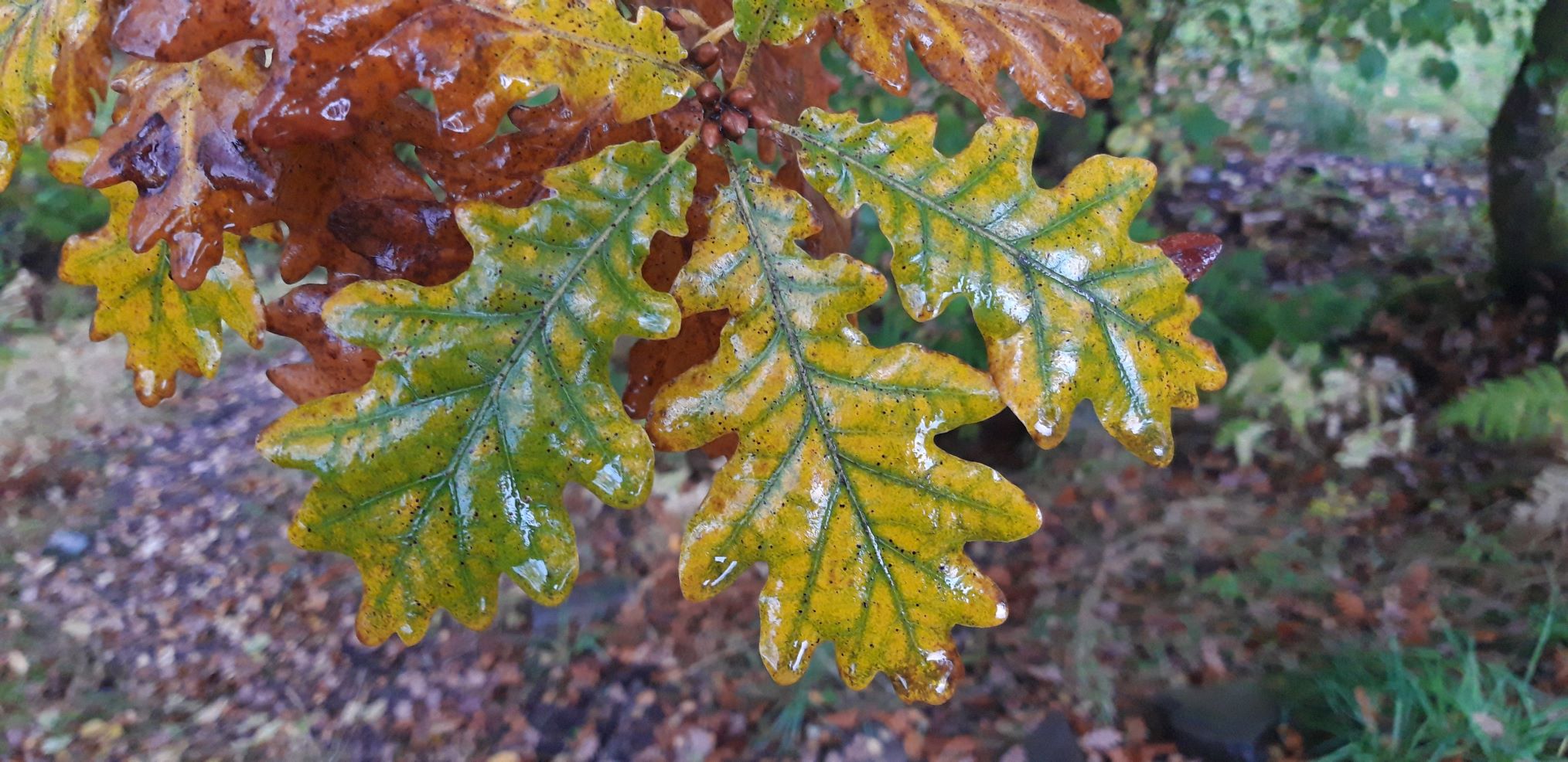
Yellow and bronze oak leaves, still with green chlorophyll in their midribs and veins.

The green hills are singeing into copper and bronze. All around us trees are drifting too into the autumn spectrum. From the yellow birch to the still green oak, with rowan, alder and hazel at varying stages between, the trees and bracken are calling back their chlorophyll.

Chlorophyll is the green pigment that allows the tree to absorb light needed for photosynthesis.  It is green to the human eye because the tree absorbs red and blue light but reflects the green.  Autumn leaves may be a sign of decay, of the trees shedding what is no longer needed, but it is when the trees are at their most energetic that we see most of their waste – green is the colour of light that the tree throws back.

Each tree reaches a point though where they have stored enough sugar under their bark and in their roots, where they cannot store any more.  Or, if they haven’t reached that point, they are forced anyway to withdraw their liquids deep within to protect themselves from the threat of coming frosts.  Unless you are a pine tree of course, then you effectively have anti-freeze in your needles and a thick layer of wax that allows you to keep your greenery all year round.  Deciduous trees however begin to prepare for their winter rest. Their chlorophyl is broken down; the carotene and anthocyanin pigments that remain in the leaves now have their chance to shine.  The sycamores near us are the first to leaf in the spring, and so seem to be of the first to turn; their five-pointed leaves appear like golden stars in a deep green sky. 

The Woodland Trust suggest that the depth of the yellows, oranges, and reds we see each year depends on weather conditions. Cold and dry weather that stays above freezing affects the pigment, giving the leaves a redder hue, as does longer spells of Autumn sunshine.  There is another theory that the vibrancy of the leaves shouts a warning.  The brighter the colour the stronger the tree – the stronger the caution to insects.  These tiny creatures may find a sheltered home for the colder months, but when spring comes this glowing tree will be capable of defence, so they’d better find another, paler, weaker, home.

Warning issued, energy reserves pulled back into the trunk and roots, the tree will seal off its branches. Leaves will be released and fall to the ground under their own weight or in the first wind.   From hereon in the wind will whistle through bare wood; without their leafy sail to catch the air the trees will be safer from storm damage, the colours of spring stored safe within. 

First published in the Lochaber Times, Issue 8536, Thursday 5 November 2020.

Sea Eagle

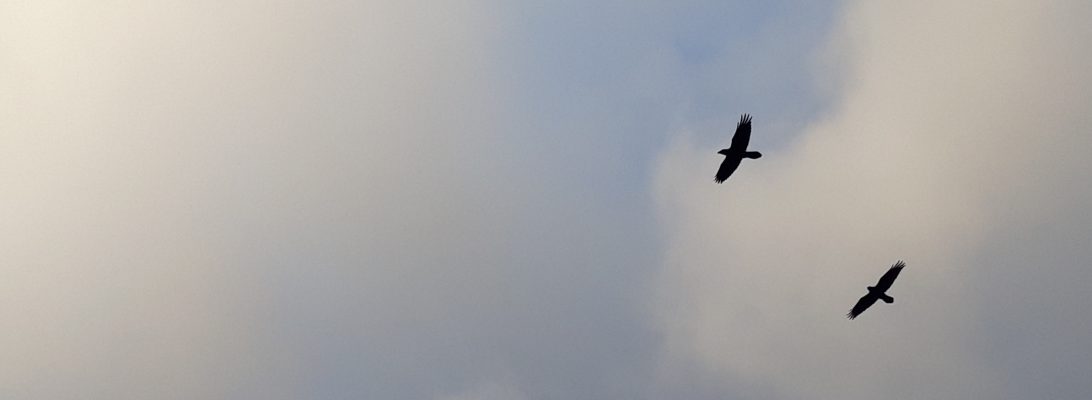
As we drove home from town along the south shore of Loch Eil, my son exclaimed ‘look at the geese mummy!’.  It turned out he meant gulls, hundreds of them, all lifting into the air at once.  Flying along the surface of the loch below them was what I first took to be a buzzard.  Slowly it dawned on me that the gull being chased by this ‘buzzard’ was not a small herring gull, it was a blackback – and a big one at that.  As my sense of scale shifted, a turn in the air revealed the pale flash of the giant persecutor’s tail.  My buzzard was a sea eagle. 

While buzzards have recovered entirely from past human persecution, sea eagles are still relatively rare. However, these huge birds once lived across the whole of the UK. 

In The Nature of Summer, Perthshire writer Jim Crumley points out the number of Highland landscape features named after the eagles that once haunted them: ‘Wherever Gaels and eagles have co-existed, there you will find crags, buttresses, rock faces and rock outcrops bearing the same name’.  Iolaire: eagle.  One of the smaller hills to the west of Glen Nevis, Bidein Bad na h-Iolaire, is one such example.  But those eagles came into competition with humans. 

A 2012 study for the British Trust for Ornithology indicated that 1500 years ago there were between 800 and 1400 pairs of white-tailed eagles across Britain and Ireland.  That number had reduced to an estimated 150 pairs by the beginning of the nineteenth century.  Another one hundred years later, in 1916, the last breeding pair were reported on Skye.  Two years later they were extinct in the British Isles.  Their names on our maps were the only echo of the eagles’ former presence. 

A re-introduction scheme began in 1975, orchestrated by NatureScot (previously Scottish Natural Heritage) and the RSPB.  As a result of the scheme there are now over 100 breeding pairs in the Highlands, but their fortunes are by no means secured.  The previous loss of eagles from this landscape is largely attributed to human activity – and we are still here. 

Leaving aside for the moment the more widely publicised disappearance of eagles over sport grouse-shooting moors, eagles pose a potential threat to the human landscape due to their predation of livestock.  In an attempt to counter any negative impact of the reintroduction scheme, NatureScot also created a White-tailed Eagle Action Plan.  The plan, which is to be reviewed this year, offers support to farmers and crofters as well as trialling prevention measures. 

Sheep are bred and cared for by people as a livelihood: a livelihood that puts a roof over our heads, that puts food on the table.  By the same token, sheep taken by sea eagles are the birds’ livelihood; they put food in their belly, they provide the energy needed for the bird to live.  Both humans and birds live off the landscape, but human and bird are still challenged to find a place for the needs of the other. 

We have a 1500-year history of intolerance towards the infringements of the white-tailed eagle into our lives; it seems we are taking small steps towards co-existing again.

Originally published as Wild Words Column, Lochaber Times, Issue 8531, Thursday 1 October 2020