Autumn colours

Yellow and bronze oak leaves, still with green chlorophyll in their midribs and veins.

The green hills are singeing into copper and bronze. All around us trees are drifting too into the autumn spectrum. From the yellow birch to the still green oak, with rowan, alder and hazel at varying stages between, the trees and bracken are calling back their chlorophyll.

Chlorophyll is the green pigment that allows the tree to absorb light needed for photosynthesis.  It is green to the human eye because the tree absorbs red and blue light but reflects the green.  Autumn leaves may be a sign of decay, of the trees shedding what is no longer needed, but it is when the trees are at their most energetic that we see most of their waste – green is the colour of light that the tree throws back.

Each tree reaches a point though where they have stored enough sugar under their bark and in their roots, where they cannot store any more.  Or, if they haven’t reached that point, they are forced anyway to withdraw their liquids deep within to protect themselves from the threat of coming frosts.  Unless you are a pine tree of course, then you effectively have anti-freeze in your needles and a thick layer of wax that allows you to keep your greenery all year round.  Deciduous trees however begin to prepare for their winter rest. Their chlorophyl is broken down; the carotene and anthocyanin pigments that remain in the leaves now have their chance to shine.  The sycamores near us are the first to leaf in the spring, and so seem to be of the first to turn; their five-pointed leaves appear like golden stars in a deep green sky. 

The Woodland Trust suggest that the depth of the yellows, oranges, and reds we see each year depends on weather conditions. Cold and dry weather that stays above freezing affects the pigment, giving the leaves a redder hue, as does longer spells of Autumn sunshine.  There is another theory that the vibrancy of the leaves shouts a warning.  The brighter the colour the stronger the tree – the stronger the caution to insects.  These tiny creatures may find a sheltered home for the colder months, but when spring comes this glowing tree will be capable of defence, so they’d better find another, paler, weaker, home.

Warning issued, energy reserves pulled back into the trunk and roots, the tree will seal off its branches. Leaves will be released and fall to the ground under their own weight or in the first wind.   From hereon in the wind will whistle through bare wood; without their leafy sail to catch the air the trees will be safer from storm damage, the colours of spring stored safe within. 

First published in the Lochaber Times, Issue 8536, Thursday 5 November 2020.

Sea Eagle

As we drove home from town along the south shore of Loch Eil, my son exclaimed ‘look at the geese mummy!’.  It turned out he meant gulls, hundreds of them, all lifting into the air at once.  Flying along the surface of the loch below them was what I first took to be a buzzard.  Slowly it dawned on me that the gull being chased by this ‘buzzard’ was not a small herring gull, it was a blackback – and a big one at that.  As my sense of scale shifted, a turn in the air revealed the pale flash of the giant persecutor’s tail.  My buzzard was a sea eagle. 

While buzzards have recovered entirely from past human persecution, sea eagles are still relatively rare. However, these huge birds once lived across the whole of the UK. 

In The Nature of Summer, Perthshire writer Jim Crumley points out the number of Highland landscape features named after the eagles that once haunted them: ‘Wherever Gaels and eagles have co-existed, there you will find crags, buttresses, rock faces and rock outcrops bearing the same name’.  Iolaire: eagle.  One of the smaller hills to the west of Glen Nevis, Bidein Bad na h-Iolaire, is one such example.  But those eagles came into competition with humans. 

A 2012 study for the British Trust for Ornithology indicated that 1500 years ago there were between 800 and 1400 pairs of white-tailed eagles across Britain and Ireland.  That number had reduced to an estimated 150 pairs by the beginning of the nineteenth century.  Another one hundred years later, in 1916, the last breeding pair were reported on Skye.  Two years later they were extinct in the British Isles.  Their names on our maps were the only echo of the eagles’ former presence. 

A re-introduction scheme began in 1975, orchestrated by NatureScot (previously Scottish Natural Heritage) and the RSPB.  As a result of the scheme there are now over 100 breeding pairs in the Highlands, but their fortunes are by no means secured.  The previous loss of eagles from this landscape is largely attributed to human activity – and we are still here. 

Leaving aside for the moment the more widely publicised disappearance of eagles over sport grouse-shooting moors, eagles pose a potential threat to the human landscape due to their predation of livestock.  In an attempt to counter any negative impact of the reintroduction scheme, NatureScot also created a White-tailed Eagle Action Plan.  The plan, which is to be reviewed this year, offers support to farmers and crofters as well as trialling prevention measures. 

Sheep are bred and cared for by people as a livelihood: a livelihood that puts a roof over our heads, that puts food on the table.  By the same token, sheep taken by sea eagles are the birds’ livelihood; they put food in their belly, they provide the energy needed for the bird to live.  Both humans and birds live off the landscape, but human and bird are still challenged to find a place for the needs of the other. 

We have a 1500-year history of intolerance towards the infringements of the white-tailed eagle into our lives; it seems we are taking small steps towards co-existing again.

Originally published as Wild Words Column, Lochaber Times, Issue 8531, Thursday 1 October 2020

Otter and stone

Not an otter

In a monotone world, snow disappearing into still water, there appears a tight swell of movement, full of languid force. Indistinct dark splashes are more often than not a far-off cormorant diving repeatedly for food, but, as the streak loops and circles, my confidence grows that maybe this time it is an otter.  

The hills on the other side of the loch fade as the drift of falling snow deepens. Perspective drifts with it, small or far away becoming blurred so that the twisting shape could be two otters – until it lifts its head and upper body out of the water in a periscope motion, returning a sense of scale. Eventually it submerges fully and I walk in the direction given by its wake, my boots scraping too noisily on stonechips, stilling steps and body in a pantomime freeze each time the otter emerges closer to the shore.

I make it onto the strip of tide-swept grass, free of snow and soft enough to quieten my feet. The grass leads towards an outcrop of basalt which tumbles into a handful of boulders, dark and proud of the pale loch. I am a cold statue as the otter swims towards them, silhouetted oh-so briefly on the surface, before vanishing into the rocks.

Two, three, slow steps. Two, three, more. Every cell alert and leaning towards the creature I imagine to be on the other side of the stone. Another two steps. Poised in expectant motion. Then

Low rumble of a male voice. I hesitate briefly, then step up onto the rock. Through the curtain of snow and branches I can just see two hooded bodies standing at the bank of the wee bay beyond. As I teeter with decision a car alarm goes off – not mine, must be theirs. I give the otter up for lost and turn back, crunching heavily along the shore back to my own car.

I am always on at my children to share nicely, to think of others, to be kind. It is not until I am driving away that it occurs to me that I could have continued to walk towards the people by the loch, whoever they were. Our pincer approach combined with the car alarm may have sent the otter melting away into the water, but what would we have gained – or given – by talking to each other about it?

My experience of nature as it relates to writing is, on the whole, a solitary affair: the ‘lone enraptured male’ so prevalent in nature writing setting a tone for much that followed. While new voices and narratives have emerged in recent years, the form is still predominantly of a single author relaying their own experiences, observations, or understanding of the living world. Some write from the clear self of first-person, others in the quietly human third, while Kathleen Jamie’s use of second-person in Surfacing goes someway to counter this solitude, her ‘you’ reaching out to bring the reader along with her and opening her words outwards. However, no matter the twists and turns of technique, the process of writing tends towards the innate perspective of the author. Or, so I thought.

Then there was Foundle, created by Tanya Shadrick, Jo Sweeting and Louisa Thomsen Brits. I had watched a little of the project’s development via Instagram, slight glimpses into the experience of the growing friendship of three women and its creative flow, in which ‘chance, skill, and intent triangulate to form art’. The emotive strength of their three-fold depiction lies in the balance and attention that each gives to the other and their work: ‘A triangle of women, the strongest shape, the weight of our attention evenly spread. Touching, listening, conjuring collective purpose.’ The idea of new bonds and collaboration was beautiful to see, and to me seemed so very brave. If I imagined myself taking part in such an endeavour, I became petrified, a stony fear creeping out from my centre until my limbs were stilled.

It was that same stone that turned me away from the couple on the shore. It is likely that they saw the otter too, rumbled their car to a stop and crept slowly towards the lochside, cameras poised, hoping to capture the moment, to make it theirs. I had wanted that moment too, senses alive to light and movement in the hope of etching its lines onto my memories, to be reformed in words at some unknown later date. I had not wanted to share.

But, there is something else here now. A testing of the stone. The possibility of a new way of carving words. I am no longer wondering about the missed opportunity of seeing the otter up close; instead, I wonder at the missed opportunity to become ‘we’.

With thanks to Tanya Shadrick, Jo Sweeting and Louisa Thomsen Brits: https://www.littletoller.co.uk/the-clearing/foundle-by-tanya-shadrick-jo-sweeting-and-louisa-thomsen-brits/

Bracken

The bracken is dying. The green hills are slowly singeing; yellow, copper, and bronze blending with some still-verdant patches, smirred into an impressionist’s pallet in Loch Linnhe below. A puffer disrupts the vision as it steams down the water, purple-black smoke streaming behind it, a novelty from a fading generation.

Though once used for bedding or mulch, bracken fern is now mainly viewed as invasive, reducing both biodiversity and the grazing territory available to farmers and crofters. To be rid of bracken you must repeatedly knock it back, two, three times in a season. Then you must repeat the process the following year. Year, upon year, upon year. If you do not, if you give the new growth an inch of space and time, it will take it and grow.

Bracken is old and bracken is persistent. Fossil records date it to at least 55 million years ago. It can quickly regenerate from the smallest of roots, rhizomes waiting patiently underground for new shoots to be allowed to unfurl, fiddleheads rising again to play with the wind, to reach above our heads so that in spring the hills ripple with soft green waves.

I cross a stile by the Polldudh track in Glen Nevis, following a path of mud-sunk footprints and flattened grass. Underneath a tall rowan, red berries still clinging to its branches, there is a hint of a gap in the bracken. Someone has already stamped through here – stalks lie snapped at right angles close to the ground. Beyond these, the greener stems slope away from me, their lush heads pulled down by the weakening below, their lower fronds now brown, cracked curls trailing the late September sunshine to its faint ends.

I put my hand out to one withered stalk, running my fingers along its dried pinnae; I thought they would crumble, disintegrate into my palm, but they are surprisingly strong. One curls around my thumb and holds tight as I pull, like a baby’s reflex, tiny fingers gripping mine.

Sound

Standing at the top of the croft and looking down the slope I can hear Lawrie calling to one of our sons. The sun shines hard and white at my back, a welcome change from the dreich grey days of winter. Even at this distance, glimpsed as he is through the birch trees, I can see his face screwed up as he looks for the boy. He is the size of a lego man from where I stand up the hill, yet when I call “Is he there?” with no great force in my voice I hear him answer “Aye”, as if I had been standing just a few metres away.

I am up the hill with a black bin bag and thick gloves, collecting rubbish dropped by the ravens. He is by the house putting up a fence to stop the sheep from destroying the garden. Neither of these activities particularly smack of crofting conventions, but as we call to each other across the ground I am struck that when this croft was created human voices would have carried across the earth, through the air, just the same. I am standing in the winter remains of long grass that in years gone by would likely have had livestock on it, so our voices would have been joined by the animals’ sonorous lowing. As it is, the bass notes now come from the rumble of forestry and landfill lorries on the single-track road by the shore below.

Earlier in the day I had been at the same task in the trees at the back of the croft next door and my phone had started ringing in my back pocket. It had been Lawrie checking that our 5 year old son, who had wandered off in my direction, had indeed found me. If he’d called with his voice alone then I doubt I would have heard him, so what would he have done before we had mobile phones? Downed tools and come to check himself I suppose, or at least come within hearing-shot. As I go further up the croft with my bag now, heading towards an oak beneath which is a midden of pecked-clean mammal bones and plastic food containers, I can still hear the reassuring sounds of the boys shouting at their game. I can hear the metallic thud of the fence-post driver as Lawrie hammers the posts into the ground. Two ravens fly in a straight line above my head; I’m alerted to them only by the soft whupping of their wings in the air. “Aye, it’s your mess I’m cleaning up”, I call up to them. Whether they hear me or not, there is no acknowledgement and they are soon gone.


Some of these short pieces are written as a result of the optional prompt for the monthly meetings of the Lochaber Writers Group.  The prompt for April was ‘Sound’.

Holding on

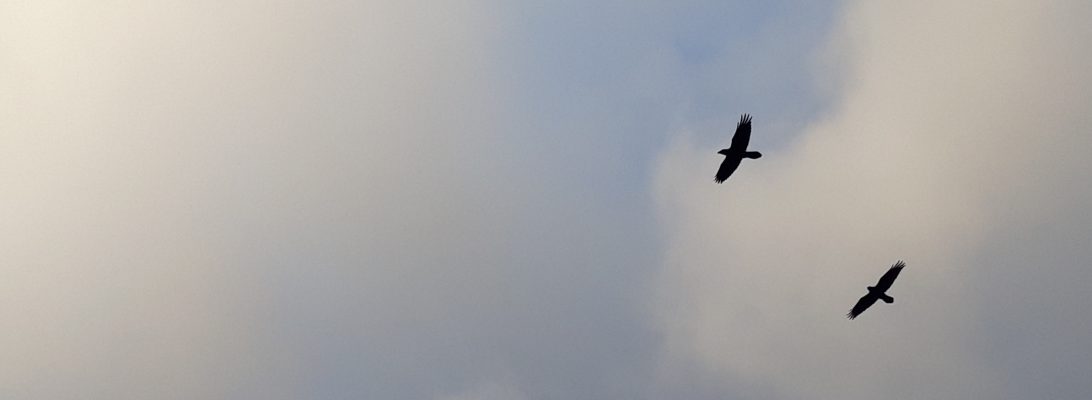
The single-track road curves away to the west, following the dark shore. Straight still pines look unsure in this undulating landscape, but when the rain sweeps in they hold steady, riding the strobing surge as one. The downpour billows wide like a net curtain released from a window flung open. Higher up, the river courses down the slopes against the wind, the water streaming off granite like smoke. There are no ravens in the sky now. What strength do the birds have to maintain their grip in the face of this onslaught?

Perhaps their strength comes from the knowledge that the tide will pass. When the worst of the storm moves before us, the sun begins to shine gently through the clouds. The deep-wine tips of the birch poke through the hillside, like the underside of embroidery, and the dun-wet rushes have been buffed to a purple shine.  At a distance the full burns rush with a faceless stony white, but seen closely their foam is creamy with peat. Raven calls begin to echo in the hall of birch; in ones and twos they lift to embrace the wind that remains. A double rainbow appears in the grey sky, but our attention is suddenly shifted down to the soft brown feathers of a buzzard tensed in a visual shriek as it swoops in a fast curve across the road, level with our headlights. Ultimately, the strength to hold on comes down to one thing: you have no other choice.

Wild Swimming (ish)

The weather has been hot for the last few days and the evening air is a white haze across the water, turning the greens of the surrounding hills into an indistinct blue. I’m hoping that the recent heatwave will have turned the top few inches of the loch a touch warmer than all the dire warnings have indicated. The ground at the shore here was recently landscaped by a digger into a makeshift slip of broken granitic gneiss and basalt,* but the stones closer to the tide, glistening russet, gold, cinnamon, honey, copper, olive, pewter, have been rolled smooth by time and water. More important to me though, at this precise moment, is that the usually-prolific bladder wrack hasn’t quite recovered from the groundworks here: it is as clear a stretch into the water as I am going to get.

I stand with my toes, still in trainers, tipping at the edge of the yellow-toned shore water.  The wind sends the surface undulating towards me. When I was wee my mum used to run the bathwater too hot, so I used to get into the bath in increments, first acclimatising my feet, then gradually letting my ankles, my shins, my thighs get used to the hot water; I inch forward now and let the waves travel up to my bare ankles.  It is cold, but as, this guy puts it, it’s somewhere between ‘no bad’ and ‘aye, it’s awright’. I have a brief moment where I think, ‘you’re nuts, this is going to be painful, just go for walk’, but then irritation kicks in: I want to know if I’m capable of this. I step further into the loch, sliding a little on the stones. I’m up to my knees.  I imagine going home now – it wouldn’t be too shameful for a first attempt, would it? But after a few minutes I take another step forward, the water now up to the tops of my thighs. My lungs seem to be trying to get away from the water as my breath suddenly starts to come in sharp and shallow. I can still see the bottom clearly though; here and there are wisps of kelp still anchored on rocks by my feet.  I remember swimming in the sea off Ardneil Bay as a kid: I was fine as long as I could put my feet down on the sand, but the minute I got into deeper water I had this same involuntary drawing in of breath, as if my body was trying to draw itself out of the water. I was afraid of the unknown, of other sea-dwellers (whatever they may be), of what lurked in the water between my feet and the seabed.  I still am.

However, I am also now becoming aware of a separation that exists between me and the natural world: barring the odd walk I have largely admired the breathtaking display of the Scottish Highlands through a pane of glass (touched on in this much earlier blog post). So I bend down and put my arms into the water up to my shoulders, feet still firmly on the ground. I breathe slowly and deeply to remind my body that it is okay where it is, that I am still only a few feet from the dry rocks at the shore. Taking one more slow deep breath I lean further forward and push my whole body into the water. A tiny splash of salt water on my lips is exhilarating – I am doing it!  I am swimming in this loch!  I swim in a tiny circle, maybe five or six breast strokes, then quickly scramble my feet back down onto the rocks that are just a couple of feet below me.  I stand up and beam into the sunlight; the sun gleams off the seawater that streams off my black leggings. The water doesn’t feel as cold now, and I push myself back into the water, again doing a little circle. I can describe little else as I am mainly focussing on catching my breath and calming it down.  I still don’t want anything to touch me, but as I swim in my tiny orbit close to the shore I start to relax enough to see the water, the liquid denim blue of the waves woven with white reflections, and golden seaweed breaking the surface at either side of my safe zone.  My eye won’t go beyond that to the hills, or even to the trees which I imagine are waving me on from the shore, but maybe next time.


* Thank you Lochaber Geopark.


Finding the ‘sacred’ – Arthur Dent style

When I walk I am usually searching for something: a different perspective, peace, escape, information, connection, understanding, or sometimes just to get breathing space, to find a return to my own head after a day with the kids; walking is a conscious act with agency behind it and within it. This morning I am woken just after 5 by Keir, who climbs and plays around us until I register that it is light. Having just finished Gary Snyder’s The Practice of the Wild, and also having the class instructions to go for a walk for a class that starts at 9 today – meditating specifically on Snyder’s thoughts in the book – I decide that now is as good a time as any. I reckon that starting the day with a conscious connection to the land I inhabit can only be a good foundation to build from (combined with the mortar of morning coffee of course.)

The wilderness pilgrim’s step-by-step breath-by-breath walk up a trail, into those snowfields, carrying all on the back, is so ancient a set of gestures as to bring a profound sense of body-mind joy.

The point is to make intimate contact with the real world, real self. ‘Sacred’ refers to that which helps take us (not only human beings) out of our little selves into the mountains-and-rivers mandala universe.

Gary Snyder, The Practice of the Wild

So, having first checked it was okay with the larger Lawrie that I could abandon him to the breakfast routine, I chuck waterproof trousers, jacket and wellies on over my jammies and head out into the universe.

My intention is to do a quick tour up the back of the croft, but I can’t help following the deer and sheep tracks that are so clear on the wet ground, tunnels of flattened grass with their tips pointing away from me like arrows, to end up at the boundary with the sliver of common grazings that lies between us and the landfill site. I stand and watch the ever-present sea of gulls that flock over the raised-up hollow of earth that holds the detritus of human lives. Hundreds of the birds lift off out of this basin in a white wave, a cycling swell of movement that brings them back round and down again like water swirling down a drain; once settled they coat the surface and line the rim like dots of icing around a cake, three ravens continuing to circle above them. The sound of the seabirds’ raucous burbling sweeps towards me, and I want to wait to see if they will lift off again, but, conscious that I have been away longer than planned, I turn for home.

Splinters of white, blue and red catch my eye here and there, plastic caught in the lee of the stone wall, in the long dead grass, and quivering in the bare branches of the birch like prayers for the sick in a clootie tree. At one point I think I see some white-brain fungus, whose gelatinous folds I am equally repulsed and amazed by, but it turns out to be a crushed plastic takeaway cup enmeshed in the sphagnum moss. Stopping at the fencepost that sits roughly where one of the ruins has been dug away for the betterment of another area of the croft, I decide to make my own wee offering to this piece of recovering land, inspired by Snyder’s spiritual approach to the landscape. I choose to make this fencepost my personal sacred marker of this sad but necessary act of demolition, and the loss of a living memorial to the people who made this land their own before us. I look around for something to put on the post and a scrap of sheep’s wool catches my eye. Though perhaps an ironic choice, given what drove the creation of crofts in the first place, I bend to pick it up – it turns out to be an opaque polythene bag.

Instead I place a piece of dried common bent grass, glistening with tiny wee stars, remnants of rainwater.

Magic raven feather

All day we have been under an oppression of heavy grey cloud, and beneath it the gusting eastern wind has turned the usually clear loch into a tempest. One thing I am learning though, as I pay more attention, as I read more, is that the ravens love the wind; so, despite being scunnered and tired, at the back of 5 I don boots and trudge up the back of the croft, heading westwards towards the neighbouring crofts where I suspect the ravens are roosting.

Perhaps it’s the day it’s been, but I am not soothed by my footsteps as I usually am. Insecurity as to what direction my writing should go in, fights with wee Lawrie about sitting in a different car seat, about what boots to wear, Keir breaking half a dozen eggs all over the kitchen (Lawrie is allergic to raw egg) and subsequently pulling the shower off the wall, toy throwing, nipping, screaming (them, not me), forgetting to buy milk – all of these things accumulate like the purple bruise of sky sagging over the pale blue-gold sunset faraway in the west. The winds have brought litter: caught in the net of birch, willow and hazel that grow along the banking are marge tubs, poly bags, takeaway packaging, bottles, cartons, shredded letters… I video a trail of blue plastic, American Beauty style, caught on a branch and twisting in the wind.

I am really only half-heartedly looking for the ravens; in truth I am just trying to get away from my mood. Nonetheless, I bother to scrawl a few notes as the ravens register me, a group of twelve taking turns to swoop round silently and pull up short in the sky above my head, held there in the wind, until they disappear as one, issuing a single croak as they go.  I spook the group again as I tramp about the undergrowth, as well as a couple of roe deer, feeling the thud of their escape through the ground and hearing their warning bark in the distance, but I still can’t pinpoint where the birds might settle. Eventually the failing light sends me homewards (and the knowledge that I should really go and help with the bedtime routine), the grump in me as heavy as the leaden skies that contrast so sharply with the white hilltops to the south.  I cross the fence at a point where it has been knocked down, and there is my gift. A single black feather. I have to double back over the fence to pick it up, but I know now that I am on the right path. I walk home clutching my feather like Dumbo, suddenly lighter. Just write about the ravens.

img_7780