Early mornings have been hidden here by Loch Eil in the last few days. Walking out into the garden is to walk into the midst of a cloud. Intangible feather-white air is dense enough to hold within it the loch, the hills, the houses on the north shore. The road is evidenced only by the spectral whoosh of a car engine rolling across the haze. A single gull call pierces through from the water, unseen, below. Around the house, the only shapes that emerge from the mist are the dark bulks of the closest trees. All others are vanished.
These water particles, extracted from the air by overnight cooling of land, shroud the world around us – but in doing so they reveal another world that is veiled from human eyes in the clarity of day.
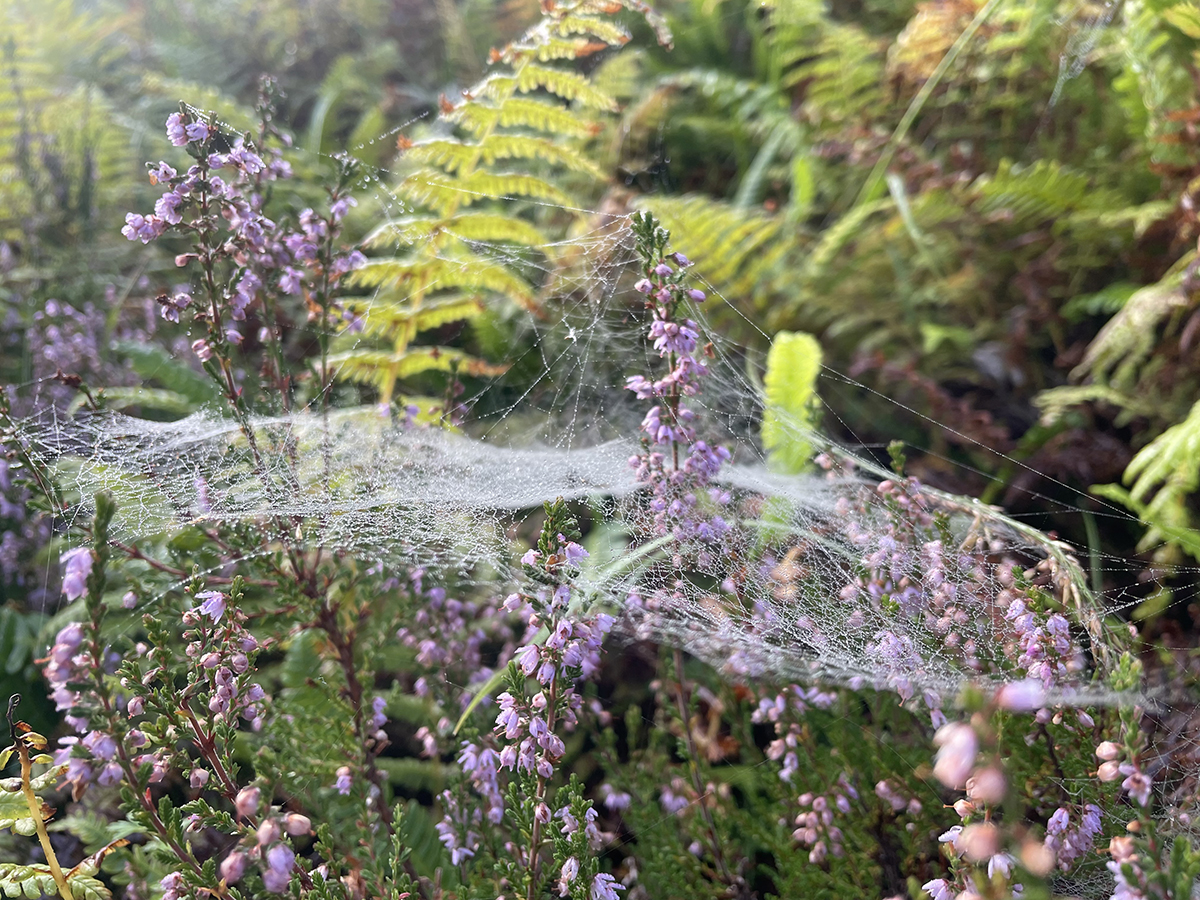
Water droplets cling to silk thread, slung imperceptibly and industriously across the vertical and horizontal and all the angles in between. Spiders’ webs. Everywhere you look. In the rushes and long grass, in the heather and fern, across the kids’ swing-frame, in the wire fence, and in a tall shepherd’s crook of a pale blade of grass, another civilisation is constructed around ours.
I read that there are almost three million spiders for each one human being, globally. Where the impact of almost 8 billion people is starkly evident on the entire surface of this planet, an estimated 21 quadrillion spiders live largely undetected, carrying out their invisible service of capturing and consuming billions of other insects.
For a brief moment, the fog that hides all else gives substance to their insubstantial structures.
Soon though, the sun’s warmth begins to reach through and the mist starts to dissipate, lingering only above the treetops and in the wee corrie tucked into the hill. Bright splashes of rowan red emerge from the trees, and gold-green specklings of birch. The web cities cling on, ghostly, vanishing slowly to the naked eye as the world around them intensifies into blue, green, and the beginnings of bronze.
By mid-day, the sun is high, the cloud now just tendrils that leave the faintest shadow on the hilltops. Wind sweeps in from the west, coming in through our open windows like a cat and knocking over a lamp. Going to right it, I look out again to the web in the heather by the house that I’d photographed that morning.
From a distance it is no longer visible – perhaps gone altogether – but as I peer closer, I see that it is still there, wavering in the wind. Its weaver, a common sheetweb spider, or money spider, clings on underneath.
First published in Lochaber Times September 2024. Republished here with permission.



 Kirsteen Bell