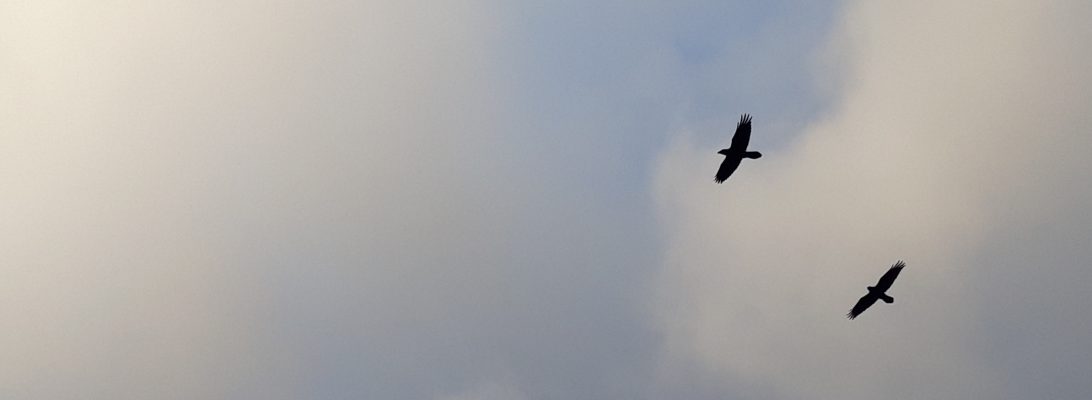
Summer and Autumn Go Head to Head

The hills are an odd mix of bronze and purple, as autumn and summer go head to head in a confusion of delicate decay and plush growth. Heather sweeps in a flush up the slopes, while around it the bracken has already started collapsing, stalks withered and weak.

From January to August last year we had seen a fairly scant 460 total hours of sunlight: this year, at the time of writing, there have been more than 650 sunlit hours since the turn of the year. These August skies have brought almost double the light to Lochaber than the same month last year. Combined with our resident rainfall, the result is a disconcerting hot green summer with more than just a whiff of autumn about it.

Weeks ago, a friend told me she and her son had come across ripe brambles, half a season ahead of their normal fruiting time. I was catching glimpses of rowan berries in July, bright beacons of summer’s end while we were still in the midst of it. Oak trees heading towards a mast year are heavy too with acorns. Or they were, until Storm Floris had its battering go at everything. 

When trees drop their leaves in autumn it is, in part, a defense mechanism against winter winds. Leaves may be small, but in the millions they catch the gusts in volumes enough to wrench even the strongest of branches, tipping trees across roads busy with tourists. One visitor stood in the high street watching the roof peel off a building and asked ‘Is this normal weather for the Highlands then?’. Well, no. And yes.

The adage of ‘four seasons in one day’ feels a little too close to the bone nowadays. The edges of the seasons are shifting, their boundaries blurring.  Where spring took forever to come last year, limping in after a long and dark winter, this year it burst from the landscape. The big oak in front of our house, usually one of the last to leaf, was in its full finery before May was out.  Now, it is peppered with brown curls, and the air around it is too quiet.

Standing at the kitchen window, my son asks what are the flock of small birds he’s just watched fly across the tree tops. Once I would have answered confidently that they might have been swallows or house martins gathering for their migration back south, but I realise now that I haven’t seen any in days.  Instead, a tiny voice in the back of my mind wonders if they might have been fieldfare arrived from the north, months ahead of schedule. Highly unlikely, says the voice of reason, as another dead leaf floats by the window, coppery in the evening sun.

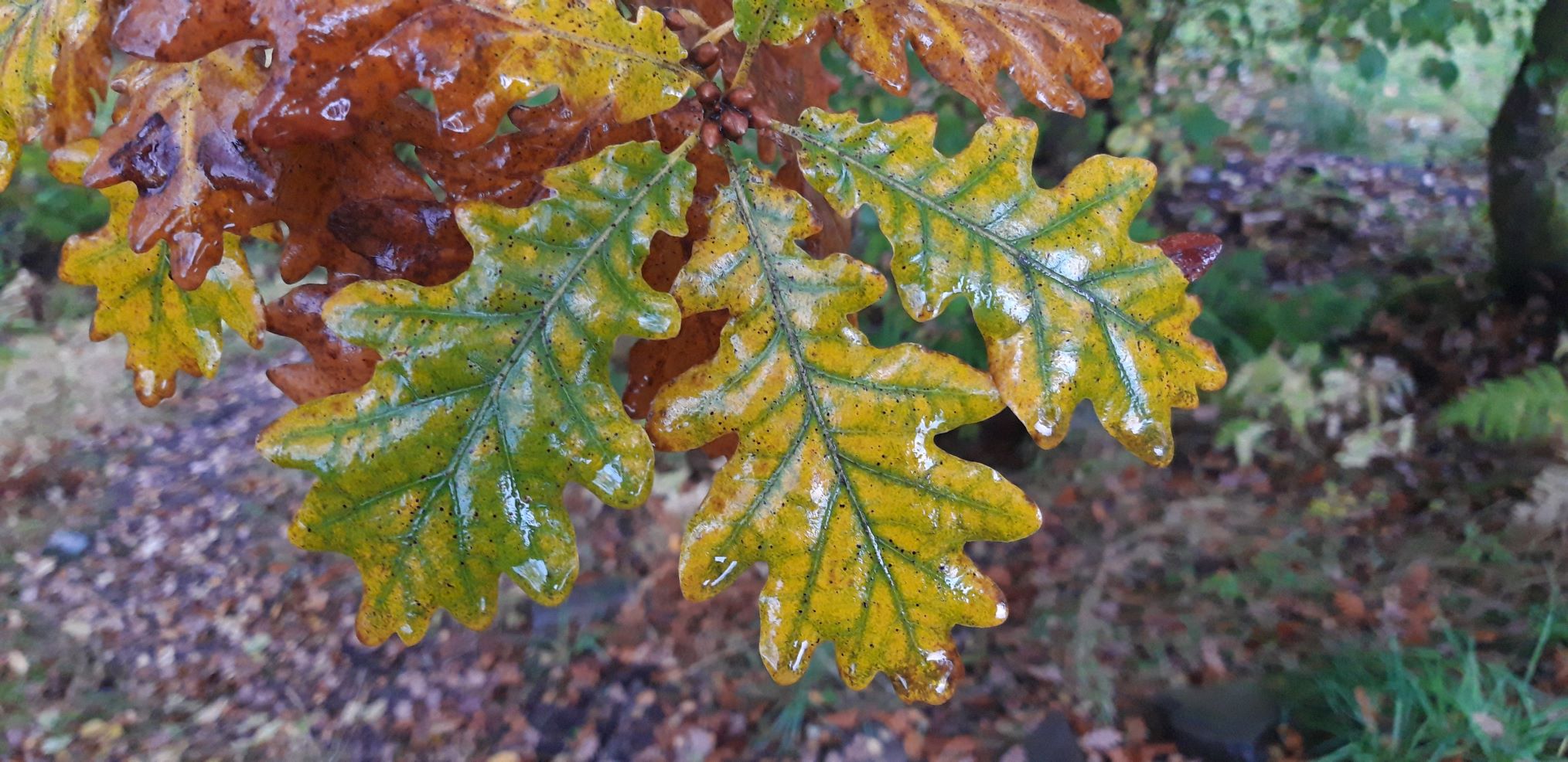
Autumn colours

Yellow and bronze oak leaves, still with green chlorophyll in their midribs and veins.

The green hills are singeing into copper and bronze. All around us trees are drifting too into the autumn spectrum. From the yellow birch to the still green oak, with rowan, alder and hazel at varying stages between, the trees and bracken are calling back their chlorophyll.

Chlorophyll is the green pigment that allows the tree to absorb light needed for photosynthesis.  It is green to the human eye because the tree absorbs red and blue light but reflects the green.  Autumn leaves may be a sign of decay, of the trees shedding what is no longer needed, but it is when the trees are at their most energetic that we see most of their waste – green is the colour of light that the tree throws back.

Each tree reaches a point though where they have stored enough sugar under their bark and in their roots, where they cannot store any more.  Or, if they haven’t reached that point, they are forced anyway to withdraw their liquids deep within to protect themselves from the threat of coming frosts.  Unless you are a pine tree of course, then you effectively have anti-freeze in your needles and a thick layer of wax that allows you to keep your greenery all year round.  Deciduous trees however begin to prepare for their winter rest. Their chlorophyl is broken down; the carotene and anthocyanin pigments that remain in the leaves now have their chance to shine.  The sycamores near us are the first to leaf in the spring, and so seem to be of the first to turn; their five-pointed leaves appear like golden stars in a deep green sky. 

The Woodland Trust suggest that the depth of the yellows, oranges, and reds we see each year depends on weather conditions. Cold and dry weather that stays above freezing affects the pigment, giving the leaves a redder hue, as does longer spells of Autumn sunshine.  There is another theory that the vibrancy of the leaves shouts a warning.  The brighter the colour the stronger the tree – the stronger the caution to insects.  These tiny creatures may find a sheltered home for the colder months, but when spring comes this glowing tree will be capable of defence, so they’d better find another, paler, weaker, home.

Warning issued, energy reserves pulled back into the trunk and roots, the tree will seal off its branches. Leaves will be released and fall to the ground under their own weight or in the first wind.   From hereon in the wind will whistle through bare wood; without their leafy sail to catch the air the trees will be safer from storm damage, the colours of spring stored safe within. 

First published in the Lochaber Times, Issue 8536, Thursday 5 November 2020.