Peals of Geese

Dusk’s gentle quiet is often split by resonating peals of geese, calling each other to roost, big sociable rafts cooried in to the sheltered waters of Loch Eil. Long black necks of Canada geese group alongside bright orange beaks and rippled brown feathers of greylags, both ploutering in amongst the seaweed-strewn shoreline. Sunlight, when it comes, reflects off the bright white chests of the Canada geese, and the pale undersides of the greylag. On clear days, the whooping seesaws of their calls mingle and carry across the water.

Greylag are so called as they migrate later than other species – lagging behind. The greylags here however are residents. When Icelandic populations were migrating back to colder climates in spring, the Lochaber birds would have begun sitting on eggs. Goslings fledge then in only eight or nine weeks, growing from a distinct soft yellow-grey to become quickly indistinguishable from the older birds in the gaggles. I love the greylag’s scientific name, Anser Anser. Their sharp persistent calls echo and do seem to demand an answer.

The Canada geese reply with a lower, slower honk. They can also be a migratory species, though again UK populations stay throughout the year. I stumbled upon a thread on the internet that claimed their North American origins were a misnomer, that the bird was actually named from an ornithologist called John Canada, but further digging indicates that to be a modern myth. The millions of Branta Canadensis Canadensis present in Canada bear out their title.

For all that the rafts of geese floating at the head of Loch Eil appear huge to my eyes, in fact there are probably only around a hundred or so. This is a tiny fraction of the hoards that descend elsewhere, such as in the Hebrides where they have become a huge problem for crofters.

Over centuries, crofting agriculture has found a balance between human and land in which both thrive. Hebridean machair has long been a biodiverse habitat that supports multiple species of birds, flowers and insects, as well as human and beast, but the geese threaten that with their voracious numbers.

Both Canada and greylag are successful breeders, each laying clutches of around 5-7 eggs. Good feeding grounds and lack of predators have allowed their populations to prosper. Since the 1980s their numbers have gradually increased into the thousands, along with other species such as barnacle geese. Geese eat grass, roots, seeds, and grain; a field just ready to harvest can be destroyed in a matter of hours.

There have been attempts from NatureScot to help manage the geese numbers, although these seem to be localised now to key areas under threat. It may well be that the numbers on Loch Eil will eventually become a problem. For now, on shores that have been silenced by the loss of lapwings and curlew, the geese are at least a sign of life.

Storming of the woods

These trees are normally quiet. We might hear the occasional blackbird song, or finches, or the alarm calls of tits and wrens, or the steady voice of ravens from above, the odd carrion crow. But this morning I walk up the hill to a raucous melee. I’m not even close to the woods before I hear a roiling mass of squeaks and curls, chortles and chips, a soundtrack sped up then run backwards and layered over itself again and again. So loud and persistent is the noise that it even swells briefly over the metallic hammering of a rockbreaker from the nearby landfill. If dictionaries had audio descriptions, clustered around the word ‘cacophony’ would be the calls of winter thrushes on the hunt for fruit.

I’ve been away for almost a fortnight and thought I might have missed this storming of the woods. We get only a fraction of the thousands of fieldfare and redwing that migrate to the north of Scotland from their breeding grounds in Scandinavia, eastern Europe, and western Russia. They come every year though, a burst of life when the Highland hills are giving up their green.

When I left for my trip in the last week of October, the rowans were still heavy with berries. Now they are finally bare.

The birds come for our autumn fruit and milder winters. Flocks flutter in like leaves lifted from branches by wind, breezing through this small belt of woodland in a brief, noisy, gathering, before moving on, leaving the rowan exhausted of their fruit. A few dried berries are left dotted on the branches here and there, and a scattering in amongst the leaf litter looks like the debris at the end of a party.

I always thought our visitors were fieldfare, but my newly downloaded Merlin Bird ID app tells me it hears redwings too. I sit by the scope in the garden, waiting for some to stray into the trees by the house so I can watch them more closely. They throng to and fro across the leafless birch, and the oaks still crinkling with brown leaves, searching for any rowan that they might have missed on the last pass. These, I am sure, are fieldfare: grey-blue blurs in the air, their undersides flashing white in the low morning sun. Then I spot two wee ones in the trailing upper branches of a silver birch – they stay long enough for me to train the glass on their perches, and even before I have increased the magnification I can see the rust glow on the side of their breast, the distinct creamy-white line above their eye. Little redwings, in amongst the fieldfare. Birds of a not-quite-the-same-feather flocking together, both drawn to the Highlands’ rowan red bounty.

Holding on

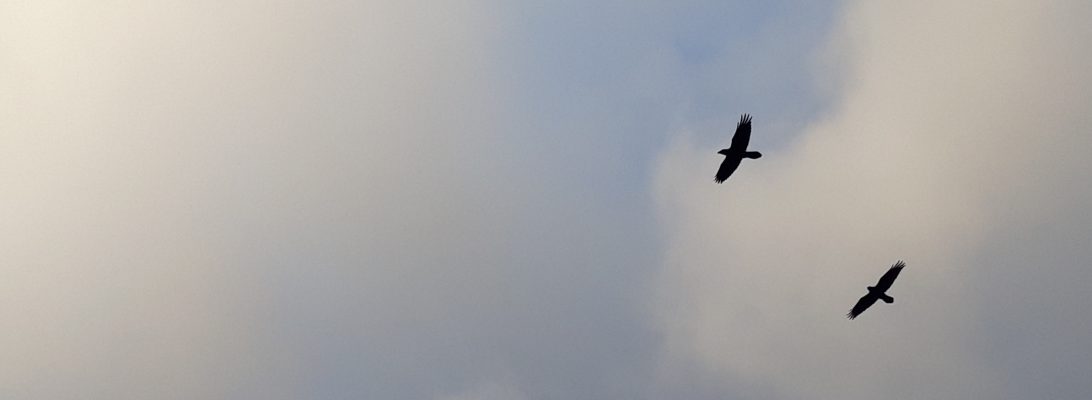
The single-track road curves away to the west, following the dark shore. Straight still pines look unsure in this undulating landscape, but when the rain sweeps in they hold steady, riding the strobing surge as one. The downpour billows wide like a net curtain released from a window flung open. Higher up, the river courses down the slopes against the wind, the water streaming off granite like smoke. There are no ravens in the sky now. What strength do the birds have to maintain their grip in the face of this onslaught?

Perhaps their strength comes from the knowledge that the tide will pass. When the worst of the storm moves before us, the sun begins to shine gently through the clouds. The deep-wine tips of the birch poke through the hillside, like the underside of embroidery, and the dun-wet rushes have been buffed to a purple shine.  At a distance the full burns rush with a faceless stony white, but seen closely their foam is creamy with peat. Raven calls begin to echo in the hall of birch; in ones and twos they lift to embrace the wind that remains. A double rainbow appears in the grey sky, but our attention is suddenly shifted down to the soft brown feathers of a buzzard tensed in a visual shriek as it swoops in a fast curve across the road, level with our headlights. Ultimately, the strength to hold on comes down to one thing: you have no other choice.