
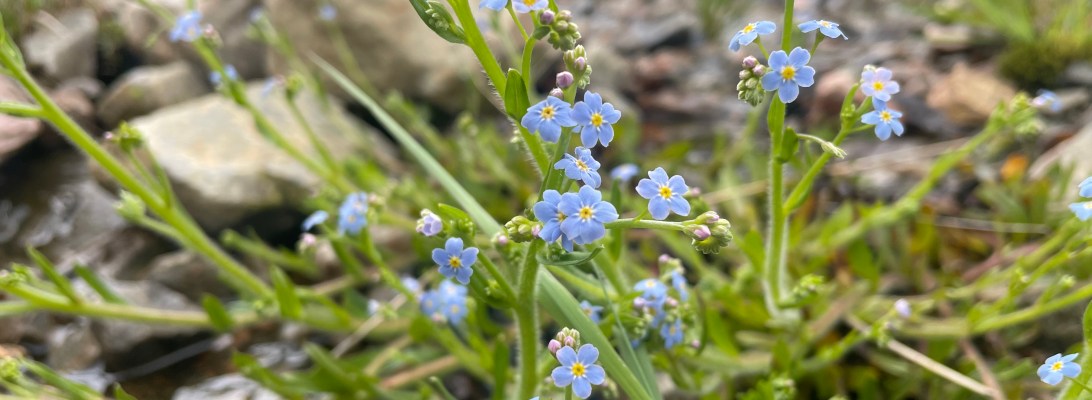
Water Forget-Me-Not

It’s no surprise to anyone that Lochaber is one of the wettest places in the UK. Look up any map showing average rainfall. Each and every one will have dark, dense colour accumulating over the land from Glenmoriston all the way down to Glen Orchy. Last year, as recorded by the Lochaber Weather station at Inchree, we had precipitation on 261 of our 365 days. All that water runs round us and over us and through the surrounding landscape, merging and flowing in drains and gutters and burns and soakaways and rivers and culverts, and ditches.

The upside of this is that when the sun casts a brief hot spell over the mountains, as it did in May, the ground keeps hold of its moisture. Gradually it does evaporate – especially from gardens with grass so short that there is no way it can hold onto any of that bounty. Nice, neat lawns desiccate and parch. But elsewhere, in those cool clefts normally designed to carry massive volumes of water, enough wetness is retained in the greenery for summer to grow on regardless.

In the ditches beside the road, leafy mats of duckweed thicken the mud below towering clumps of yellow-flag iris. There is a pageant of those flowers that reappears along the A830 at Kinlocheil every year: sharp green swords a metre tall topped with golden fleur de lis. In the open ditches on our croft, clumps of grassy ferns push out from between dry stone and soil, spindly buttercups twine their faint red stalks up and over the sides, and yellow tormentil with its jagged splays of leaves climb up through the rushes, alongside big leafy bursts of dock plants topped with long clusters of ruddy flowers.

Deeper, closer to the still damp ground, barely-there florets of white bittercress compete with miniature mountains of common haircap moss, each frond proud like a tiny pine tree, and there, growing right in the faintest trickle, are delicate blue clusters of water forget-me-not. As if we could.

Here we are in June and the ground drains are again full. Rivulets run silver with reflected clouds and gather in pools made copper by peaty earth. Those fissures cut into the ground along roadsides, through fields, around gardens and houses, sheltered the spring growth from the worst of the sun’s heat. Now they have become a sanctuary from wild westerly winds and lashing sleety showers. The wee forget-me-nots are heavy with beads of rain. For a moment though, with their roots safe in moisture-rich soil, their soft sky-coloured petals and yellow star hearts shone, open-faced to the sun.

With thanks to www.lochaberwx.co.uk for the weather data.

An Abundance of Gorse

A pal asked me recently what colour comes to mind when I think of spring. At the time I answered, ‘new grass green’; I think I’d like to revise that now to yellow. No, not just yellow – bright, bursting, exuberant gorse yellow.

Always abundant, gorse, or whin, seems to have exploded this year and can be found almost everywhere I look. Great mounds of it grow on low knolls beneath the hills along the Mallaig road; it erupts from the verges and climbs every inch of steep stone on the run up to Inverness; it rolls in vast yellow seas in the moorland above Drum; festoons the canal paths and the low ridge below Banavie Quarry, and even at Caol swing park it shines from behind the trees, gilding the Blar.

The sun’s new heat releases sweet clouds of coconut-vanilla fragrance from the flowers, like you can breathe in warmth.  Petal overlaps petal upon petal upon petal, in a riot of softness that contrasts with the hard green spikes standing guard among them.

Those soft petals belie their hardiness. Gorse flowers from winter through into spring, and can be found coated with ice just as often as its yellow meets matching sunlight. The sharp stems seem more indicative of its tenacity. It loves our acidic heathland soils and can stand to be exposed to all that the Highland weather can throw at it.

Despite its year-round bright beauty, I don’t ever recall seeing it in people’s gardens. Reforesting Scotland’s Tree Planter’s Guide to the Galaxy does say that gorse is used as hedging in Scotland and as windbreaks for livestock. It’s no less unruly than the more popular rhododendron, spreading its seeds widely in the heat of summer, but it is infinitely more beneficial to wildlife and to us.

Instead of choking out existing flora and fauna as the rhoddies do, gorse’s stiff, dense stems create shelter for birds and can help to protect new tree growth from deer browsing. Though it doesn’t mind the poor soil, it is a nitrogen fixer and so improves soil fertility for other species to take root in the future. The flowers are an early source of nectar for bees and are also edible to humans (unlike the poisonous rhoddies), used as garnish for salads or steeped in tea or wine.

There’s certainly enough to go around. You’d need to be fairly hardy yourself to tackle gathering the flowers, protected as they are by that army of spikes. I stopped to gather just a few, for no other reason than to have the scent in my hand. I earned more than a few stabs for my scant efforts, so good luck to ye!

reliable brightness

March has come softly, a thin leak of sunshine cresting the hills and alighting on the first heralds of spring. They are small, quiet, at first: tiny snowdrops, hazel catkins shining gold, the deep red of birch filling with sap, threads of purple crocus twisting out of the earth – and then come the bright brash trumpets of daffodil.

Even the daffodils’ beginnings are radiant, tapering tips of yellow like candles that wait to unfurl in a blaze of colour, beaming brighter with the light of each lengthening day. At the beginning of the month, green spears clustering on north facing slopes still keep their shadows, but, by the time we reach April, they will be as wide open as those whose faces are now gathering the sun from the south. Each time I drive past the Marie Curie Field of Hope in Claggan, more flowers have appeared, like stars bursting through the dark.

Daffodils were brought to the UK by the Romans. They would apparently chew the bulbs for pain relief, those numbing narcotic qualities that gave the flower genus its Latin name, ‘narcissus’. The bulbs, leaves and petals all do contain lycorine, which is toxic when ingested. For this reason, they seem to be one of the few spring plants growing wild that survive the onslaught from otherwise starving and voracious sheep.

Its common name, daffodil, is a derivative of asphodel, which famously beautified the fields of the ancient Greek afterlife. Daffodil perfume drifts lightly over the wet decay of winter. For me, daffodils are a wee reminder of what’s to come, a look ahead to the orange-yellow flames of bog asphodel that ignite in amongst the hill heather under summer sun, and a promise of resilience.

What’s the phrase for March? In like a lion out like a lamb? Or is it the other way around – I can never remember. If the saying came from recognition of reliable weather patterns, then in the current shifting climate it’s little wonder I don’t know which way around it’s supposed to be. There is another theory though that the saying comes from the stars: the constellation Leo rising in the night skies at the beginning of the month, while Aries, the ram, arises for its end. Like the daffodils, those stars are clusters of brilliance that come out consistently, regardless of what we throw at them.

Even the heaviest deluge of rain doesn’t seem to batter these flowers out of existence. Their heads are weighted by the weather, yes, but not crushed. Water beads on the outer petals that still splay around each strong central corona, luminous and open, and well suited to the eccentricities of a Scottish spring.