Adjusting to Light

October has brought a changed air, crisping and cooling in a gentle precursor to the onslaught of winter wind that comes from the north. Sunset has crept further into the day, and now, with the changing of the clocks, the balance of our days is shifting earlier into evening.

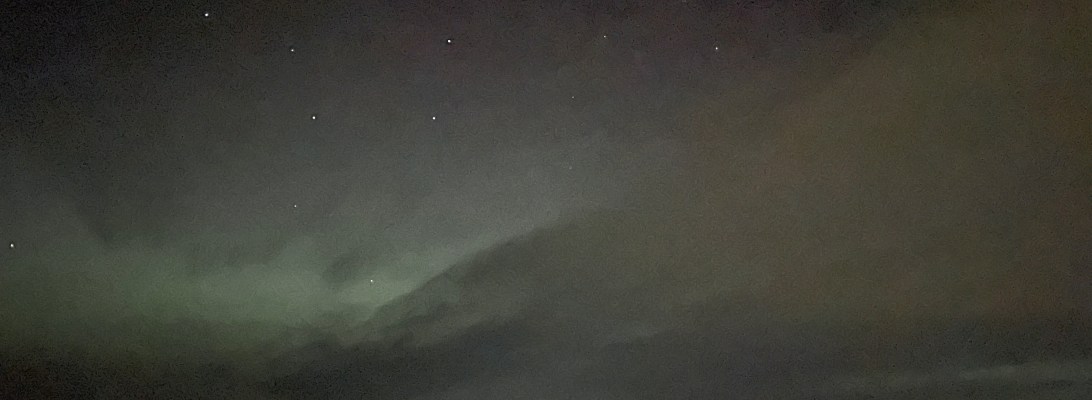
Less light however rarely means total darkness. The northern lights called us out just before the new moon, a faint green wash that could almost be imagined flickering above the hills. We switched off the house lights in an attempt to see them better, blending the garden and ourselves back into the night.

The departing light also takes with it the stream of noise emitted by our human world: voices, phones, TV, music, all fading from the air. From the glen over the water, we can hear the belligerent bellows of rutting stags. A pair of oyster catchers peep up from the nearby shore, while a female tawny owl haunts the trees behind us. Her solitary keewik remains unanswered, one half of twit as yet missing a male’s twoo refrain.

Writing in The Living Mountain on her one night sleeping outside under an October sky, Nan Shepherd told of ‘a night of the purest witchery, to make one credit all the tales of glamourie that Scotland tries so hard to refute and cannot.’ On a practical level, I know that we’re watching sun particles collide with the planet’s atmosphere. The shadowed flittering hints of Na Fir-Chlis, the nimble men, feel like a glamourie all the same: wisping movement and colour just beyond the realm of vision, just out of sight of my too-slow eyes.

Our eyes have evolved to function best in daylight, and it takes around ten to thirty minutes for sight to adapt enough to see those particles of light that filter through the dark. In the first few seconds, our pupils expand to let in as much available light as possible. Then, over the next ten minutes, the colour-gathering cones in our retinas reactivate the light sensitive chemicals left dormant during the day. If we stayed out for longer to watch that faint aurora, the rods in our eyes responsible for black and white vision would increase their sensitivity over several hours, opening further to the hidden magic of the night.

A quick snap with my phone camera would confirm the sight of those skybound dancers straight away, but just one glance at the phone screen would reset  my eyes back to their default daylight settings. So instead we wait for the shifting green light to brighten, and for the stars that were there all along to emerge.

Summer and Autumn Go Head to Head

The hills are an odd mix of bronze and purple, as autumn and summer go head to head in a confusion of delicate decay and plush growth. Heather sweeps in a flush up the slopes, while around it the bracken has already started collapsing, stalks withered and weak.

From January to August last year we had seen a fairly scant 460 total hours of sunlight: this year, at the time of writing, there have been more than 650 sunlit hours since the turn of the year. These August skies have brought almost double the light to Lochaber than the same month last year. Combined with our resident rainfall, the result is a disconcerting hot green summer with more than just a whiff of autumn about it.

Weeks ago, a friend told me she and her son had come across ripe brambles, half a season ahead of their normal fruiting time. I was catching glimpses of rowan berries in July, bright beacons of summer’s end while we were still in the midst of it. Oak trees heading towards a mast year are heavy too with acorns. Or they were, until Storm Floris had its battering go at everything. 

When trees drop their leaves in autumn it is, in part, a defense mechanism against winter winds. Leaves may be small, but in the millions they catch the gusts in volumes enough to wrench even the strongest of branches, tipping trees across roads busy with tourists. One visitor stood in the high street watching the roof peel off a building and asked ‘Is this normal weather for the Highlands then?’. Well, no. And yes.

The adage of ‘four seasons in one day’ feels a little too close to the bone nowadays. The edges of the seasons are shifting, their boundaries blurring.  Where spring took forever to come last year, limping in after a long and dark winter, this year it burst from the landscape. The big oak in front of our house, usually one of the last to leaf, was in its full finery before May was out.  Now, it is peppered with brown curls, and the air around it is too quiet.

Standing at the kitchen window, my son asks what are the flock of small birds he’s just watched fly across the tree tops. Once I would have answered confidently that they might have been swallows or house martins gathering for their migration back south, but I realise now that I haven’t seen any in days.  Instead, a tiny voice in the back of my mind wonders if they might have been fieldfare arrived from the north, months ahead of schedule. Highly unlikely, says the voice of reason, as another dead leaf floats by the window, coppery in the evening sun.

Peals of Geese

Dusk’s gentle quiet is often split by resonating peals of geese, calling each other to roost, big sociable rafts cooried in to the sheltered waters of Loch Eil. Long black necks of Canada geese group alongside bright orange beaks and rippled brown feathers of greylags, both ploutering in amongst the seaweed-strewn shoreline. Sunlight, when it comes, reflects off the bright white chests of the Canada geese, and the pale undersides of the greylag. On clear days, the whooping seesaws of their calls mingle and carry across the water.

Greylag are so called as they migrate later than other species – lagging behind. The greylags here however are residents. When Icelandic populations were migrating back to colder climates in spring, the Lochaber birds would have begun sitting on eggs. Goslings fledge then in only eight or nine weeks, growing from a distinct soft yellow-grey to become quickly indistinguishable from the older birds in the gaggles. I love the greylag’s scientific name, Anser Anser. Their sharp persistent calls echo and do seem to demand an answer.

The Canada geese reply with a lower, slower honk. They can also be a migratory species, though again UK populations stay throughout the year. I stumbled upon a thread on the internet that claimed their North American origins were a misnomer, that the bird was actually named from an ornithologist called John Canada, but further digging indicates that to be a modern myth. The millions of Branta Canadensis Canadensis present in Canada bear out their title.

For all that the rafts of geese floating at the head of Loch Eil appear huge to my eyes, in fact there are probably only around a hundred or so. This is a tiny fraction of the hoards that descend elsewhere, such as in the Hebrides where they have become a huge problem for crofters.

Over centuries, crofting agriculture has found a balance between human and land in which both thrive. Hebridean machair has long been a biodiverse habitat that supports multiple species of birds, flowers and insects, as well as human and beast, but the geese threaten that with their voracious numbers.

Both Canada and greylag are successful breeders, each laying clutches of around 5-7 eggs. Good feeding grounds and lack of predators have allowed their populations to prosper. Since the 1980s their numbers have gradually increased into the thousands, along with other species such as barnacle geese. Geese eat grass, roots, seeds, and grain; a field just ready to harvest can be destroyed in a matter of hours.

There have been attempts from NatureScot to help manage the geese numbers, although these seem to be localised now to key areas under threat. It may well be that the numbers on Loch Eil will eventually become a problem. For now, on shores that have been silenced by the loss of lapwings and curlew, the geese are at least a sign of life.

Water Forget-Me-Not

It’s no surprise to anyone that Lochaber is one of the wettest places in the UK. Look up any map showing average rainfall. Each and every one will have dark, dense colour accumulating over the land from Glenmoriston all the way down to Glen Orchy. Last year, as recorded by the Lochaber Weather station at Inchree, we had precipitation on 261 of our 365 days. All that water runs round us and over us and through the surrounding landscape, merging and flowing in drains and gutters and burns and soakaways and rivers and culverts, and ditches.

The upside of this is that when the sun casts a brief hot spell over the mountains, as it did in May, the ground keeps hold of its moisture. Gradually it does evaporate – especially from gardens with grass so short that there is no way it can hold onto any of that bounty. Nice, neat lawns desiccate and parch. But elsewhere, in those cool clefts normally designed to carry massive volumes of water, enough wetness is retained in the greenery for summer to grow on regardless.

In the ditches beside the road, leafy mats of duckweed thicken the mud below towering clumps of yellow-flag iris. There is a pageant of those flowers that reappears along the A830 at Kinlocheil every year: sharp green swords a metre tall topped with golden fleur de lis. In the open ditches on our croft, clumps of grassy ferns push out from between dry stone and soil, spindly buttercups twine their faint red stalks up and over the sides, and yellow tormentil with its jagged splays of leaves climb up through the rushes, alongside big leafy bursts of dock plants topped with long clusters of ruddy flowers.

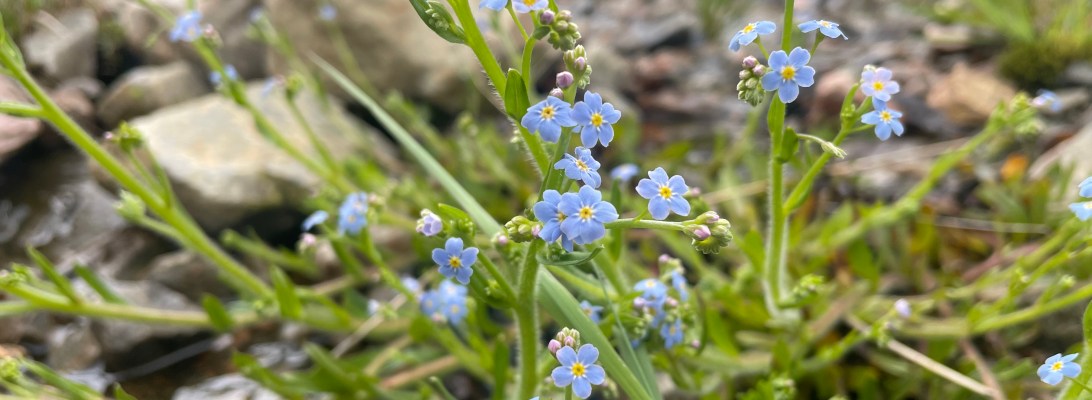
Deeper, closer to the still damp ground, barely-there florets of white bittercress compete with miniature mountains of common haircap moss, each frond proud like a tiny pine tree, and there, growing right in the faintest trickle, are delicate blue clusters of water forget-me-not. As if we could.

Here we are in June and the ground drains are again full. Rivulets run silver with reflected clouds and gather in pools made copper by peaty earth. Those fissures cut into the ground along roadsides, through fields, around gardens and houses, sheltered the spring growth from the worst of the sun’s heat. Now they have become a sanctuary from wild westerly winds and lashing sleety showers. The wee forget-me-nots are heavy with beads of rain. For a moment though, with their roots safe in moisture-rich soil, their soft sky-coloured petals and yellow star hearts shone, open-faced to the sun.

With thanks to www.lochaberwx.co.uk for the weather data.

An Abundance of Gorse

A pal asked me recently what colour comes to mind when I think of spring. At the time I answered, ‘new grass green’; I think I’d like to revise that now to yellow. No, not just yellow – bright, bursting, exuberant gorse yellow.

Always abundant, gorse, or whin, seems to have exploded this year and can be found almost everywhere I look. Great mounds of it grow on low knolls beneath the hills along the Mallaig road; it erupts from the verges and climbs every inch of steep stone on the run up to Inverness; it rolls in vast yellow seas in the moorland above Drum; festoons the canal paths and the low ridge below Banavie Quarry, and even at Caol swing park it shines from behind the trees, gilding the Blar.

The sun’s new heat releases sweet clouds of coconut-vanilla fragrance from the flowers, like you can breathe in warmth.  Petal overlaps petal upon petal upon petal, in a riot of softness that contrasts with the hard green spikes standing guard among them.

Those soft petals belie their hardiness. Gorse flowers from winter through into spring, and can be found coated with ice just as often as its yellow meets matching sunlight. The sharp stems seem more indicative of its tenacity. It loves our acidic heathland soils and can stand to be exposed to all that the Highland weather can throw at it.

Despite its year-round bright beauty, I don’t ever recall seeing it in people’s gardens. Reforesting Scotland’s Tree Planter’s Guide to the Galaxy does say that gorse is used as hedging in Scotland and as windbreaks for livestock. It’s no less unruly than the more popular rhododendron, spreading its seeds widely in the heat of summer, but it is infinitely more beneficial to wildlife and to us.

Instead of choking out existing flora and fauna as the rhoddies do, gorse’s stiff, dense stems create shelter for birds and can help to protect new tree growth from deer browsing. Though it doesn’t mind the poor soil, it is a nitrogen fixer and so improves soil fertility for other species to take root in the future. The flowers are an early source of nectar for bees and are also edible to humans (unlike the poisonous rhoddies), used as garnish for salads or steeped in tea or wine.

There’s certainly enough to go around. You’d need to be fairly hardy yourself to tackle gathering the flowers, protected as they are by that army of spikes. I stopped to gather just a few, for no other reason than to have the scent in my hand. I earned more than a few stabs for my scant efforts, so good luck to ye!

Spring: BaTS

There are buds and new leaves burgeoning on the trees, there are daffodils and daisies and coltsfoot, there are cuckoo flowers and cuckoos to come  – and then there are bats. Of all the signs of spring, it is the quiet, almost imperceptible, re-emergence of the last in that list that I love the most.

Swinging open my door this evening to let the dog out, three small bird-like shapes whisk across my eyeline and up into the twilight. Pipistrelles, soprano pipistrelles I think, their dancing around the gutters of our house silhouetted against the half-light of dusk. 

If the air is still enough, as it is tonight, it is possible to hear a faint leathery flittering of wings, but that’s all. My youngest son has been learning about echolocation in school and watches with me. We are unable to hear the clicks and squeaks that bounce off the bats’ surroundings and back to them, telling them where the house is, where we are, where the flies are that they seek. The sounds that bats emit are so high-pitched they are invisible to us, just as the bats themselves fade into the night as it deepens.

I would love to know where they spent the winter, what wee cool nook they found sheltered enough to hibernate in. Their fur is dark and brown enough that they could disappear into any small cleft in the woods, blending into woodpecker holes, or the hollows left by broken branches. Or they could have found some quiet spot in the eaves of the workshed, or even the house.

Over and over again I think of the word ‘synanthrope’: from Greek syn, ‘together with’, and anthropos, ‘man’ – creatures that are wild, yet whose ongoing survival benefits from sharing space with humans.

As with many species, the natural habitats of bats have declined as human habitats have expanded. And so bats have adapted to us, learnt to make our homes theirs too. Despite that adaptation, The Bat Conservation Trust highlights that numbers have declined over the last hundred years. Bat roosts are now protected by law in the UK, which means that if I were to find that the roost is in our house, there it would stay.

Even if I wasn’t already naturally fond of these creatures who have clung on, the Trust’s website is reassuring that they pose little risk. Unlike mice, bats don’t chew pipe-lagging or wires, and their droppings harbour no known health risks and will simply crumble to dust. Their presence generally has no direct impact on our lives.

In fact, silent as they are to us, if I wasn’t outside this evening I might not have noticed them at all.

Sighting wild boar

Anyone who drives the roads around Lochaber at night will have caught glimpses of wildlife in the verge: headlights glancing off the gold line of a woodcock’s beak, or the twin green reflections of a pine marten’s eyes – not to mention those glimpses of antlers or a soft brown back that send your foot to the brake pedal in anticipation of a stag or roe deer running out.  Driving home late last week though, just before Invergarry where the forest grows close to the road, my foot hit the pedal. Not at something running towards me, but at an unfamiliar long dark shape climbing the bank away from me.

I reversed back up the stretch of empty road, window opening to the night, trying to sharpen my eyes into the shadows to confirm what I had seen. The movement had been too low to be a deer, too black, and the way its weight shifted against the slope reminded me of pigs we’ve kept on the croft. Boar.

A growing population of wild boar call the woods of the Great Glen their home, but I have never seen one.  Huge they may be – an adult can be almost a metre tall at its shoulders, with immense strength behind their elongated snouts and short tusks – they are known to be secretive beasts.

Once a keystone species in woodland habitat, boar had dropped out of our collective consciousness for centuries. They can be integral to healthy and balanced woodland regeneration, disturbing undergrowth to allow new trees to take root, and creating space for wildflowers like bluebells to reach through to the light. However, they are not wholly welcome in the human landscape.

Sightings have been recorded in the south at Leanachan Forest, on trail cameras in Glen Loy and Loch Arkaig, and north by farmland and estates near Drumnadrochit. Each time I drive the road between Fort William and Inverness my peripheral vision keeps an awareness in the trees, hoping out the corner of my eye to snag on a heavier presence in amongst the scrubby understory of birch and oak, or the quiet emptiness of the conifers. I never really expected to see the wild pigs so close to the road though.

The numbers of wild boar in the Great Glen have reportedly been increasing in recent years, with more anecdotal evidence of sightings from walkers on the Great Glen Way, particularly on the approach into Inverness.  The messages on Facebook walking boards are mostly of warning, and many farmers and crofters see them as nothing short of a nuisance, as they can dig up land used for grazing.

Like so much wildlife in the Scottish Highlands, there are multiple ways in which we can interpret the boars’ presence, for good or bad. I gave up staring into the dark forest and resumed my journey home, knowing the boar had far more patience with which to outwait me. It will carry on trying to live its life and we will carry on our trying to live ours. Whether we can find a happy medium that allows both human and boar to co-exist remains to be seen.

Holly harvest

I am advancing through the woods with a pair of sharp kitchen scissors in hand, my heading set by a gleam of green. It’s early, the sun is only just edging around the Ben in the east. Light filters weakly through wet air, softening the edges of birch and oak around me – but not the sharp points of the holly tree I am here to see.

The ground underneath is littered with leaves blown from the oaks further up the bank, mouldering shades of burgundy and brown, and a pair of yellowing ribwort leaves missed by the deer, by the winter, protected maybe by the lower holly branches.

This single holly tree sits brightly by a group of pale birch. It is tall, half my height again, but still a sapling. The crown leaves have not yet forgotten their need to be spiky. Nearby, the trunk of a young rowan has been fractured by the shouldering weight of stags: its broken branches demonstrate how far the holly needs to grow before it is out of the deer’s browsing reach.

Holly is common in the understory of oakwoods, even a tiny one like this. When faced with the emptiness of dark gnarled wood, you can see why its shine and colour are so closely associated with Christmas and yuletide. Evergreen and crimson, it is a burst of brightness as we approach the depths of winter. The smooth verdant surface of the leaves invites touch – were it not for those points that snag and scratch. And fruit that ripens in winter is a gift, though it needs a frost to sweeten the bitter berries for the birds that will eat and disperse its seeds.

It is too young to be prolific in fruit yet, this wee tree that could live for 300 years if left alone. Will these woods even be here then? At first, I spot only one berry, and, having just been reading Robin Wall Kimmerer, I pause before snipping the branch. In Braiding Sweetgrass, she writes about the Honourable Harvest, the agreement between people and land in which you take only what you need: ‘Never take the first. Never take the last. … Leave some for others’.

I take a photo of the one red berry instead. However, the longer I stand there, getting my eye in, waiting for the morning light to curl around the tree’s tips, more red starts to pop out. Eventually I spy a branch with a cluster of three little berries. I step in closer, scissors ready. This scant trio are less than half of what the tree still holds, and they are exactly what I need.

Storming of the woods

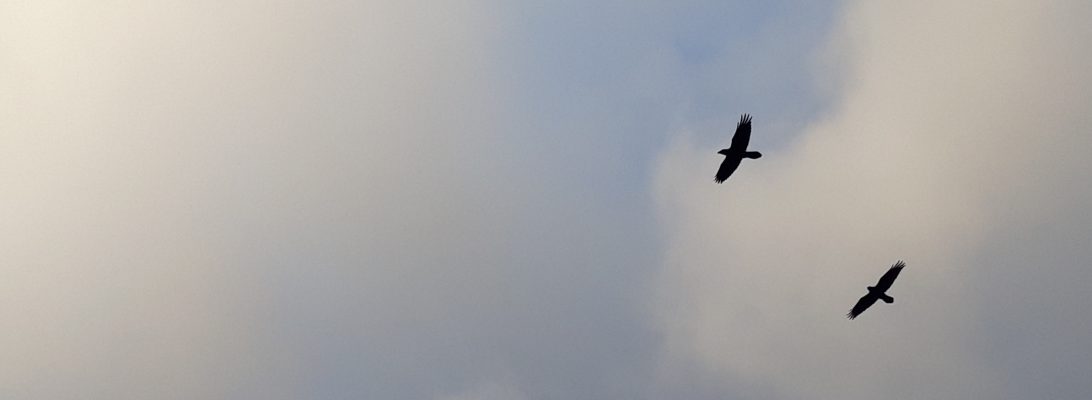
These trees are normally quiet. We might hear the occasional blackbird song, or finches, or the alarm calls of tits and wrens, or the steady voice of ravens from above, the odd carrion crow. But this morning I walk up the hill to a raucous melee. I’m not even close to the woods before I hear a roiling mass of squeaks and curls, chortles and chips, a soundtrack sped up then run backwards and layered over itself again and again. So loud and persistent is the noise that it even swells briefly over the metallic hammering of a rockbreaker from the nearby landfill. If dictionaries had audio descriptions, clustered around the word ‘cacophony’ would be the calls of winter thrushes on the hunt for fruit.

I’ve been away for almost a fortnight and thought I might have missed this storming of the woods. We get only a fraction of the thousands of fieldfare and redwing that migrate to the north of Scotland from their breeding grounds in Scandinavia, eastern Europe, and western Russia. They come every year though, a burst of life when the Highland hills are giving up their green.

When I left for my trip in the last week of October, the rowans were still heavy with berries. Now they are finally bare.

The birds come for our autumn fruit and milder winters. Flocks flutter in like leaves lifted from branches by wind, breezing through this small belt of woodland in a brief, noisy, gathering, before moving on, leaving the rowan exhausted of their fruit. A few dried berries are left dotted on the branches here and there, and a scattering in amongst the leaf litter looks like the debris at the end of a party.

I always thought our visitors were fieldfare, but my newly downloaded Merlin Bird ID app tells me it hears redwings too. I sit by the scope in the garden, waiting for some to stray into the trees by the house so I can watch them more closely. They throng to and fro across the leafless birch, and the oaks still crinkling with brown leaves, searching for any rowan that they might have missed on the last pass. These, I am sure, are fieldfare: grey-blue blurs in the air, their undersides flashing white in the low morning sun. Then I spot two wee ones in the trailing upper branches of a silver birch – they stay long enough for me to train the glass on their perches, and even before I have increased the magnification I can see the rust glow on the side of their breast, the distinct creamy-white line above their eye. Little redwings, in amongst the fieldfare. Birds of a not-quite-the-same-feather flocking together, both drawn to the Highlands’ rowan red bounty.