

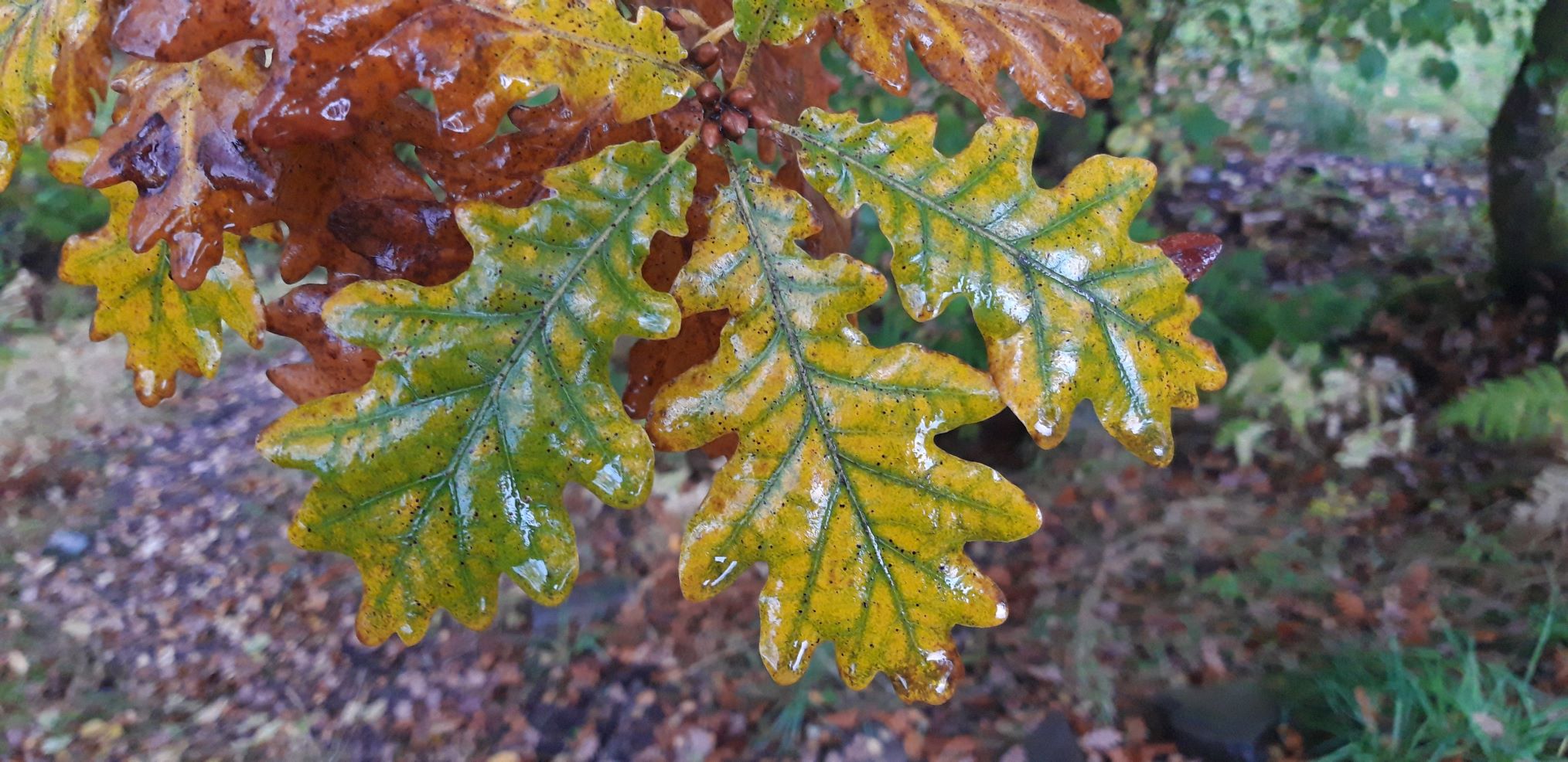
The green hills are singeing into copper and bronze. All around us trees are drifting too into the autumn spectrum. From the yellow birch to the still green oak, with rowan, alder and hazel at varying stages between, the trees and bracken are calling back their chlorophyll.
Chlorophyll is the green pigment that allows the tree to absorb light needed for photosynthesis. It is green to the human eye because the tree absorbs red and blue light but reflects the green. Autumn leaves may be a sign of decay, of the trees shedding what is no longer needed, but it is when the trees are at their most energetic that we see most of their waste – green is the colour of light that the tree throws back.
Each tree reaches a point though where they have stored enough sugar under their bark and in their roots, where they cannot store any more. Or, if they haven’t reached that point, they are forced anyway to withdraw their liquids deep within to protect themselves from the threat of coming frosts. Unless you are a pine tree of course, then you effectively have anti-freeze in your needles and a thick layer of wax that allows you to keep your greenery all year round. Deciduous trees however begin to prepare for their winter rest. Their chlorophyl is broken down; the carotene and anthocyanin pigments that remain in the leaves now have their chance to shine. The sycamores near us are the first to leaf in the spring, and so seem to be of the first to turn; their five-pointed leaves appear like golden stars in a deep green sky.
The Woodland Trust suggest that the depth of the yellows, oranges, and reds we see each year depends on weather conditions. Cold and dry weather that stays above freezing affects the pigment, giving the leaves a redder hue, as does longer spells of Autumn sunshine. There is another theory that the vibrancy of the leaves shouts a warning. The brighter the colour the stronger the tree – the stronger the caution to insects. These tiny creatures may find a sheltered home for the colder months, but when spring comes this glowing tree will be capable of defence, so they’d better find another, paler, weaker, home.
Warning issued, energy reserves pulled back into the trunk and roots, the tree will seal off its branches. Leaves will be released and fall to the ground under their own weight or in the first wind. From hereon in the wind will whistle through bare wood; without their leafy sail to catch the air the trees will be safer from storm damage, the colours of spring stored safe within.
First published in the Lochaber Times, Issue 8536, Thursday 5 November 2020.

 Kirsteen Bell