
It’s no surprise to anyone that Lochaber is one of the wettest places in the UK. Look up any map showing average rainfall. Each and every one will have dark, dense colour accumulating over the land from Glenmoriston all the way down to Glen Orchy. Last year, as recorded by the Lochaber Weather station at Inchree, we had precipitation on 261 of our 365 days. All that water runs round us and over us and through the surrounding landscape, merging and flowing in drains and gutters and burns and soakaways and rivers and culverts, and ditches.
The upside of this is that when the sun casts a brief hot spell over the mountains, as it did in May, the ground keeps hold of its moisture. Gradually it does evaporate – especially from gardens with grass so short that there is no way it can hold onto any of that bounty. Nice, neat lawns desiccate and parch. But elsewhere, in those cool clefts normally designed to carry massive volumes of water, enough wetness is retained in the greenery for summer to grow on regardless.
In the ditches beside the road, leafy mats of duckweed thicken the mud below towering clumps of yellow-flag iris. There is a pageant of those flowers that reappears along the A830 at Kinlocheil every year: sharp green swords a metre tall topped with golden fleur de lis. In the open ditches on our croft, clumps of grassy ferns push out from between dry stone and soil, spindly buttercups twine their faint red stalks up and over the sides, and yellow tormentil with its jagged splays of leaves climb up through the rushes, alongside big leafy bursts of dock plants topped with long clusters of ruddy flowers.
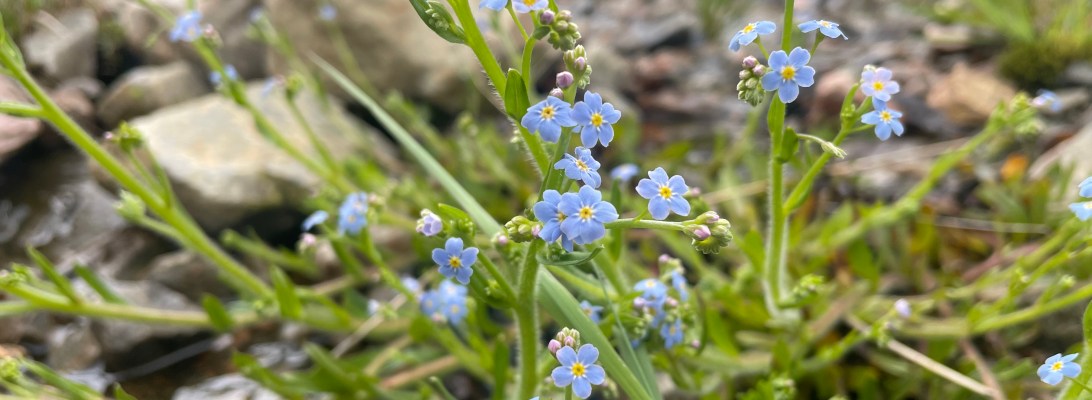
Deeper, closer to the still damp ground, barely-there florets of white bittercress compete with miniature mountains of common haircap moss, each frond proud like a tiny pine tree, and there, growing right in the faintest trickle, are delicate blue clusters of water forget-me-not. As if we could.
Here we are in June and the ground drains are again full. Rivulets run silver with reflected clouds and gather in pools made copper by peaty earth. Those fissures cut into the ground along roadsides, through fields, around gardens and houses, sheltered the spring growth from the worst of the sun’s heat. Now they have become a sanctuary from wild westerly winds and lashing sleety showers. The wee forget-me-nots are heavy with beads of rain. For a moment though, with their roots safe in moisture-rich soil, their soft sky-coloured petals and yellow star hearts shone, open-faced to the sun.
With thanks to www.lochaberwx.co.uk for the weather data.

 Kirsteen Bell