Sound

Standing at the top of the croft and looking down the slope I can hear Lawrie calling to one of our sons. The sun shines hard and white at my back, a welcome change from the dreich grey days of winter. Even at this distance, glimpsed as he is through the birch trees, I can see his face screwed up as he looks for the boy. He is the size of a lego man from where I stand up the hill, yet when I call “Is he there?” with no great force in my voice I hear him answer “Aye”, as if I had been standing just a few metres away.

I am up the hill with a black bin bag and thick gloves, collecting rubbish dropped by the ravens. He is by the house putting up a fence to stop the sheep from destroying the garden. Neither of these activities particularly smack of crofting conventions, but as we call to each other across the ground I am struck that when this croft was created human voices would have carried across the earth, through the air, just the same. I am standing in the winter remains of long grass that in years gone by would likely have had livestock on it, so our voices would have been joined by the animals’ sonorous lowing. As it is, the bass notes now come from the rumble of forestry and landfill lorries on the single-track road by the shore below.

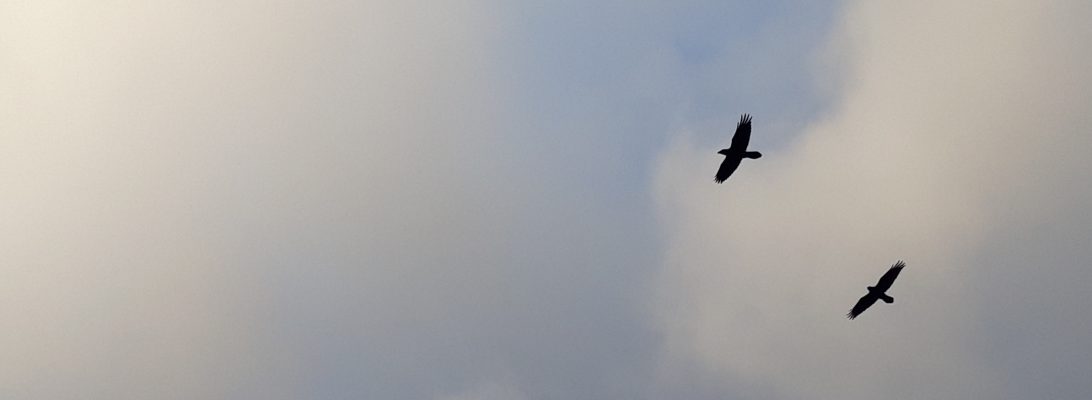
Earlier in the day I had been at the same task in the trees at the back of the croft next door and my phone had started ringing in my back pocket. It had been Lawrie checking that our 5 year old son, who had wandered off in my direction, had indeed found me. If he’d called with his voice alone then I doubt I would have heard him, so what would he have done before we had mobile phones? Downed tools and come to check himself I suppose, or at least come within hearing-shot. As I go further up the croft with my bag now, heading towards an oak beneath which is a midden of pecked-clean mammal bones and plastic food containers, I can still hear the reassuring sounds of the boys shouting at their game. I can hear the metallic thud of the fence-post driver as Lawrie hammers the posts into the ground. Two ravens fly in a straight line above my head; I’m alerted to them only by the soft whupping of their wings in the air. “Aye, it’s your mess I’m cleaning up”, I call up to them. Whether they hear me or not, there is no acknowledgement and they are soon gone.


Some of these short pieces are written as a result of the optional prompt for the monthly meetings of the Lochaber Writers Group.  The prompt for April was ‘Sound’.

Holding on

The single-track road curves away to the west, following the dark shore. Straight still pines look unsure in this undulating landscape, but when the rain sweeps in they hold steady, riding the strobing surge as one. The downpour billows wide like a net curtain released from a window flung open. Higher up, the river courses down the slopes against the wind, the water streaming off granite like smoke. There are no ravens in the sky now. What strength do the birds have to maintain their grip in the face of this onslaught?

Perhaps their strength comes from the knowledge that the tide will pass. When the worst of the storm moves before us, the sun begins to shine gently through the clouds. The deep-wine tips of the birch poke through the hillside, like the underside of embroidery, and the dun-wet rushes have been buffed to a purple shine.  At a distance the full burns rush with a faceless stony white, but seen closely their foam is creamy with peat. Raven calls begin to echo in the hall of birch; in ones and twos they lift to embrace the wind that remains. A double rainbow appears in the grey sky, but our attention is suddenly shifted down to the soft brown feathers of a buzzard tensed in a visual shriek as it swoops in a fast curve across the road, level with our headlights. Ultimately, the strength to hold on comes down to one thing: you have no other choice.

Finding the ‘sacred’ – Arthur Dent style

When I walk I am usually searching for something: a different perspective, peace, escape, information, connection, understanding, or sometimes just to get breathing space, to find a return to my own head after a day with the kids; walking is a conscious act with agency behind it and within it. This morning I am woken just after 5 by Keir, who climbs and plays around us until I register that it is light. Having just finished Gary Snyder’s The Practice of the Wild, and also having the class instructions to go for a walk for a class that starts at 9 today – meditating specifically on Snyder’s thoughts in the book – I decide that now is as good a time as any. I reckon that starting the day with a conscious connection to the land I inhabit can only be a good foundation to build from (combined with the mortar of morning coffee of course.)

The wilderness pilgrim’s step-by-step breath-by-breath walk up a trail, into those snowfields, carrying all on the back, is so ancient a set of gestures as to bring a profound sense of body-mind joy.

The point is to make intimate contact with the real world, real self. ‘Sacred’ refers to that which helps take us (not only human beings) out of our little selves into the mountains-and-rivers mandala universe.

Gary Snyder, The Practice of the Wild

So, having first checked it was okay with the larger Lawrie that I could abandon him to the breakfast routine, I chuck waterproof trousers, jacket and wellies on over my jammies and head out into the universe.

My intention is to do a quick tour up the back of the croft, but I can’t help following the deer and sheep tracks that are so clear on the wet ground, tunnels of flattened grass with their tips pointing away from me like arrows, to end up at the boundary with the sliver of common grazings that lies between us and the landfill site. I stand and watch the ever-present sea of gulls that flock over the raised-up hollow of earth that holds the detritus of human lives. Hundreds of the birds lift off out of this basin in a white wave, a cycling swell of movement that brings them back round and down again like water swirling down a drain; once settled they coat the surface and line the rim like dots of icing around a cake, three ravens continuing to circle above them. The sound of the seabirds’ raucous burbling sweeps towards me, and I want to wait to see if they will lift off again, but, conscious that I have been away longer than planned, I turn for home.

Splinters of white, blue and red catch my eye here and there, plastic caught in the lee of the stone wall, in the long dead grass, and quivering in the bare branches of the birch like prayers for the sick in a clootie tree. At one point I think I see some white-brain fungus, whose gelatinous folds I am equally repulsed and amazed by, but it turns out to be a crushed plastic takeaway cup enmeshed in the sphagnum moss. Stopping at the fencepost that sits roughly where one of the ruins has been dug away for the betterment of another area of the croft, I decide to make my own wee offering to this piece of recovering land, inspired by Snyder’s spiritual approach to the landscape. I choose to make this fencepost my personal sacred marker of this sad but necessary act of demolition, and the loss of a living memorial to the people who made this land their own before us. I look around for something to put on the post and a scrap of sheep’s wool catches my eye. Though perhaps an ironic choice, given what drove the creation of crofts in the first place, I bend to pick it up – it turns out to be an opaque polythene bag.

Instead I place a piece of dried common bent grass, glistening with tiny wee stars, remnants of rainwater.

Magic raven feather

All day we have been under an oppression of heavy grey cloud, and beneath it the gusting eastern wind has turned the usually clear loch into a tempest. One thing I am learning though, as I pay more attention, as I read more, is that the ravens love the wind; so, despite being scunnered and tired, at the back of 5 I don boots and trudge up the back of the croft, heading westwards towards the neighbouring crofts where I suspect the ravens are roosting.

Perhaps it’s the day it’s been, but I am not soothed by my footsteps as I usually am. Insecurity as to what direction my writing should go in, fights with wee Lawrie about sitting in a different car seat, about what boots to wear, Keir breaking half a dozen eggs all over the kitchen (Lawrie is allergic to raw egg) and subsequently pulling the shower off the wall, toy throwing, nipping, screaming (them, not me), forgetting to buy milk – all of these things accumulate like the purple bruise of sky sagging over the pale blue-gold sunset faraway in the west. The winds have brought litter: caught in the net of birch, willow and hazel that grow along the banking are marge tubs, poly bags, takeaway packaging, bottles, cartons, shredded letters… I video a trail of blue plastic, American Beauty style, caught on a branch and twisting in the wind.

I am really only half-heartedly looking for the ravens; in truth I am just trying to get away from my mood. Nonetheless, I bother to scrawl a few notes as the ravens register me, a group of twelve taking turns to swoop round silently and pull up short in the sky above my head, held there in the wind, until they disappear as one, issuing a single croak as they go.  I spook the group again as I tramp about the undergrowth, as well as a couple of roe deer, feeling the thud of their escape through the ground and hearing their warning bark in the distance, but I still can’t pinpoint where the birds might settle. Eventually the failing light sends me homewards (and the knowledge that I should really go and help with the bedtime routine), the grump in me as heavy as the leaden skies that contrast so sharply with the white hilltops to the south.  I cross the fence at a point where it has been knocked down, and there is my gift. A single black feather. I have to double back over the fence to pick it up, but I know now that I am on the right path. I walk home clutching my feather like Dumbo, suddenly lighter. Just write about the ravens.

img_7780