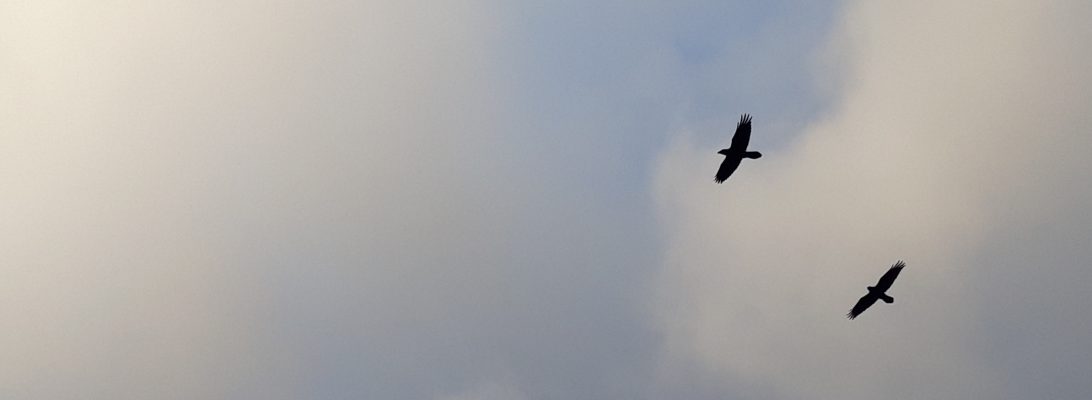
All day we have been under an oppression of heavy grey cloud, and beneath it the gusting eastern wind has turned the usually clear loch into a tempest. One thing I am learning though, as I pay more attention, as I read more, is that the ravens love the wind; so, despite being scunnered and tired, at the back of 5 I don boots and trudge up the back of the croft, heading westwards towards the neighbouring crofts where I suspect the ravens are roosting.
Perhaps it’s the day it’s been, but I am not soothed by my footsteps as I usually am. Insecurity as to what direction my writing should go in, fights with wee Lawrie about sitting in a different car seat, about what boots to wear, Keir breaking half a dozen eggs all over the kitchen (Lawrie is allergic to raw egg) and subsequently pulling the shower off the wall, toy throwing, nipping, screaming (them, not me), forgetting to buy milk – all of these things accumulate like the purple bruise of sky sagging over the pale blue-gold sunset faraway in the west. The winds have brought litter: caught in the net of birch, willow and hazel that grow along the banking are marge tubs, poly bags, takeaway packaging, bottles, cartons, shredded letters… I video a trail of blue plastic, American Beauty style, caught on a branch and twisting in the wind.
I am really only half-heartedly looking for the ravens; in truth I am just trying to get away from my mood. Nonetheless, I bother to scrawl a few notes as the ravens register me, a group of twelve taking turns to swoop round silently and pull up short in the sky above my head, held there in the wind, until they disappear as one, issuing a single croak as they go. I spook the group again as I tramp about the undergrowth, as well as a couple of roe deer, feeling the thud of their escape through the ground and hearing their warning bark in the distance, but I still can’t pinpoint where the birds might settle. Eventually the failing light sends me homewards (and the knowledge that I should really go and help with the bedtime routine), the grump in me as heavy as the leaden skies that contrast so sharply with the white hilltops to the south. I cross the fence at a point where it has been knocked down, and there is my gift. A single black feather. I have to double back over the fence to pick it up, but I know now that I am on the right path. I walk home clutching my feather like Dumbo, suddenly lighter. Just write about the ravens.

 Kirsteen Bell