
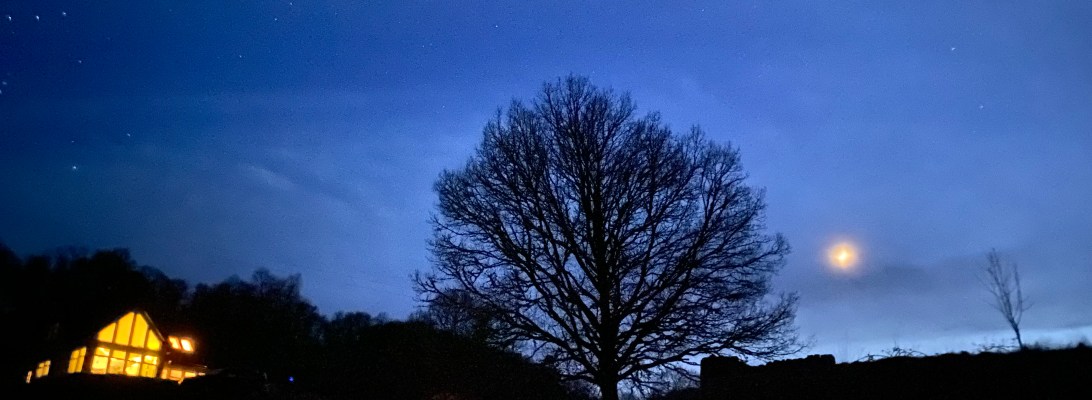
It is easy to romanticise the past lives of Highland landscapes in summer, when hillsides are light-filled and lush with green. I daydream then about reroofing the tumbled stone ruin in front of our own new-build home, imagining its empty windows filled again with warmth. In the book Romantic Lochaber, written in 1939, Donald B. MacCulloch describes the houses on this side of Loch Eil as ‘snug little Highland cottages’, ‘reposing at the foot of gently rising green hill slopes’. January, however, tells a harsher story.
Walking against the wind, up the side of the knoll on which the ruin sits, ‘gentle’ is the furthest word from your mind. Instead of a roof, long oak branches sway wildly above the open walls. From the windows of our house nearby, light spills in great splaying rectangles that only just reach the thin edges of the oak tree and the lichen-crusted stone beneath. Inside the old home is black.
The walls of the ruin are thick, almost three feet across. In daylight you can see their construction: two dykes of heavy grey stone held together by their own weight, the space between them filled in with smaller rocks and shards. I enter the dark space of the doorway, finding a seat by memory – a big lump of stone that has fallen into the one-room inner. The ground underfoot is soft with grass and dank with leaves. Sitting, my back rests on the cold and wet of moss. From here I can see out into the night, across the loch to the wee lights of houses on the opposite shore, just as the woman of this house must once have done too.
The only two window openings are north facing, so the corners now exposed to the elements would always have been in shadow, even in the day. I try to imagine where the hearth would have been, how far a fire’s heat would have radiated. How much warmer would these walls have been in January’s past?
Over the course of the month, sunrise will creep earlier a minute or two each day. But as January closes it will still be well after eight in the morning before the darkness lifts, and it will return before five in the afternoon. Average temperatures are usually around four of five degrees Celsius, and gales scour us from the west.
Despite this home’s ruined state though, the wind can’t travel through the walls. It must push at the sides, climb over the open top, bend round the still sharp right-angles of the door-less entry. I wonder again at repairing the stone, cladding it over, fitting a door, and windows with shutters. ‘Snug’ may seem a stretch, but it is possible to imagine how this home held the light close against the January night.
 Kirsteen Bell